I have now worked at Medlar on three occasions. I did a back-to-back, double shift the first time, where we did around 20 covers for lunch and 40-something for dinner. After receiving some positive reviews, the restaurant has been fully booked in the evenings.
My second experience was dinner service last Friday, when we did over 60 covers. Dinner service starts at 5.30pm with staff supper, in the kitchen for the brigade, in the dining room for the front of house staff. The first bookings are at 7pm, so you have just over an hour to finalise your mise-en-place. Once the checks start printing in the corner by the pass, the evening flies by. It pays to be organised and to know where everything is in your fridges. Hence the expression: mise-en-place.
There can be a dozen checks on the pass, each at different stages. At one stage, I was asked to count up the number of wood pigeons on order: fourteen, all at different stages of cooking. The oven was full and Andrew, the sauce chef, was operating at full throttle. It was amazing to witness. The grill burns on his forearms are testimony to the fact that he operates in the hottest, most dangerous part of the kitchen.
If things go wrong during service, bottlenecks occur. A cod was dropped on the floor - start again: the 3 second rule only applies only in domestic kitchens! We ran out of bearnaise sauce, mid-service, so I found myself making a fresh batch at about 10pm. Andrew was giving me quantities and instructions, while carving wood pigeon breasts and rack of lamb: melt 250 grams of butter and trickle it into 90 grams of egg yolks. I was terrified of splitting it and having to start again. I am allergic to eggs, so I have never made bearnaise or a hollandaise sauce. Feeling somewhat inadequate, I resolved to spend Sunday evening revising Delia's chapter on eggs, as it's clearly a weakness for me.
Once the last checks went out after 10.30pm, we started cleaning down the stoves. If television manages to portray any glamour in professional cooking, it is because they leave out details such as thick black rubber gloves, scouring pads, hot cast iron stoves and water that turns black almost immediately with burnt-on food and sauce. Meanwhile the pastry chef was still sending out desserts. The pastry chef has the short straw; if the restaurant bakes their own bread, he is often first to start and last to finish.
My third and latest experience at Medlar was lunch shift on Wednesday. Joe gave the larder chef the morning off and charged me with three cold starters. Salad of tongue (delicious, but not that popular), thinly sliced pork belly and tartare of sea trout. Unfortunately, none of these can compete with the crab raviolo, which accounts for around half of starter orders, so out of around 20 covers, there were only two orders for sea trout. Despite this, I found it much more difficult than I expected. Although I'd reorganised my fridges and prepped all of my mise-en-place, it's fair to say that I didn't know where everything was, which put us under pressure when I was responsible for some of the cold garnishes on the hot dishes.
Before, during and after service, there were enormous amounts of prep to do, aggravated by the fact that the suppliers were late to deliver. One of my first jobs was to break down the most enormous block of butter into smaller portions. That is my largest knife in the photo (about 20 cm or twice the size of a normal supermarket pack of butter). I have cut myself several times at home, but never cutting butter. I felt like I had committed the classic rookie error - cutting myself in the kitchen. Joe teased me as I went to find a plaster: "man down". I managed to pick up two further nicks that day, one removing the rind from a side of pork belly. I don't know how I picked up the other one, but I noticed while I was squeezing a lemon.
Back home, there is also lots of prep to do as Hector is starting to enjoy solid food and we are offering him new tastes. We started with pureed fruit, but he has quite quickly learnt to chew with his toothless gums and loves soft fruit such as ripe pears and orange segments. It may even encourage us to breakfast healthily, as he enjoys porridge, strawberries and blueberries. On the vegetable front, he has tried potato, sweet potato, carrots, peas, butternut squash and broccoli. Like me when I was young, he harvests the florets, omits the stalk and drops it onto the table in disdain. Now he is moving onto protein such as chicken and mushroom risotto and barbecued snapper. It seems to be agreeing with him, if this smile is anything to go by.
My name is Andrew and that's what they called me on MasterChef, but most people call me Koj.
Half Scottish, Half Japanese. Tempura Mars bar?
- Koj
- I began writing this blog in October 2010 as a new father documenting food in his family. Before I knew it, I was in the final of MasterChef 2012. Now cooking is no longer just a hobby.
Friday, 13 May 2011
Thursday, 5 May 2011
Returning to Medlar
Yesterday, although Masterchef's TV cameras weren't there to expose my inexperience and nerves, I was dropped straight into the deep end of a professional kitchen - one that last week received a higher rating from Fay Maschler than Jason Atherton’s much hyped Pollen Street Social.
The night before, I felt like a little boy on the eve of starting a new school. I selected four knives (large chef's knife, smaller chopping knife, flexible filleting knife and small paring knife), sharpened them and folded them inside a tea towel. I packed a bottle of water and I laid out what I thought I should wear: a sports shirt (in case it was hot), jeans and a pair of trainers.
The next morning, Jemma asked me if I would like a sandwich to take to work. I chortled as I declined her offer: I was working in a kitchen - I could eat there! I set off just before 8am without even having breakfast. Time flew by. I eventually completed my first 8 hour shift having eaten nothing all day but a spoonful of left over sorbet, a slice of focaccia and a latte.
Staff at many kitchens in London operate double shifts, starting at 8am and finishing around 11pm, with an hour or two break between lunch and dinner service. The first shift is mainly about 'mise-en-place' - which is French for 'put in place', i.e. preparing everything you can before customers start to arrive. Among the list of my jobs during that first shift was squeezing 40 blood oranges, chopping 30 shallots, sweating and pureeing 5 celeriac and 2 dozen turnips, finely chopping 10 leeks, peeling, de-seeding and chopping 50 tomatoes, shelling and peeling hundreds of butter beans, cutting a score of ravioli sheets and checking 1 kilogram of crab meat for shell and cartilage.
When you are 'prepping' in those sorts of volumes, it pays to find the most efficient ways of doing things and avoid putting strain on your body. Thus, you specialise in certain tasks through repetition, stand near the counter and keep everything within arms length. By 10am, I was already complaining of sore legs and a gentle burn in my lower back. Varicose veins are common in those who choose catering as a career and rookies often suffer elephantiasis of the lower limbs. Hands and forearms are subjected to cuts, burns and irritation from constant exposure to acids such as citrus fruits and vinegar.
Kitchens, especially in London, where property is expensive, tend to be small. At Medlar, the main kitchen area is not much bigger than our kitchen at home, but accommodates six chefs and a kitchen porter. In one corner, the pastry chef, Max, started the day baking sourdough and focaccia. Near him, the larder chef, Morteza, took responsibility for checking vegetable deliveries. The larder chef is one of the junior chefs in the kitchen, usually responsible for cold starters. He was overseen by Andrew, the sous chef, who was in charge of the sauce section. In some restaurants, 'sauce' specifically refers to meat, but here it also means fish. Between them by rank but not location, was Cosmo, who helped with hot starters and mains, with access to the stoves, frier (for chips) and water baths (for pasta). I took a station between Cosmo and Andrew. With my back to the stoves, the oven and the salamander (the overhead grill), it was one of the hottest places in the kitchen to stand, not that I was offered a choice. Head chef, Joe, stood opposite me for most of the morning, mucking in with general prep jobs such as shelling beans and making pasta dough.
One of the first lessons I learned was in etiquette. Due to the restricted space and potential dangers, I noticed chefs calling "Show" as they passed behind one another. Joe explained that this was in fact "Chaud", French for hot. For lunch service, Joe occupied the space by the 'pass', the heated shelf where dishes are plated and passed to the waiting staff. As tickets came down from the dining room, Joe would call "Summage: trout, crab, cod, wood pigeon, 6 minutes." Summage, I later found out, was in fact a bastardisation of the French 'ca marche' meaning 'let's get it going'. In order that the whole table receives their dishes at the same time, each of the chefs has to be able to get their dishes to the pass in 6 minutes. Too bad if their dish is popular.
Since lunch was reasonably quiet, the chefs would go back to their mise-en-place during breaks in service. By 3pm, the only guests still in the restaurant were some fellow chefs enjoying their day off and as things wound down, Joe told me to take a break at 4pm. I returned just after 5pm, about to start my second shift as the 9 till 5 workers were dispersing from the tube station. Andrew had made a big pot of mushroom and pea risotto for staff dinner at 5.30pm. Here I realised the difference between front of house staff and kitchen staff. The former, dressed smartly in crisp shirts and pressed trousers, filed past to collect a plate of food and took it to a table in the dining room to eat together. The latter, stood at their stations in aprons stained by a day's cooking, revising check lists and finishing jobs. It was like forwards and backs in rugby, I thought: same sport, totally different types of people - different physiques, different attitudes, different culture.
From the first orders at 7pm, until the last mains went out at around 10pm, the checks came in thick and fast, with a crescendo just after 9pm, when tensions rose as the chefs battled to prevent bottle necks in the service. There was little time for prepping during dinner service except when Joe had to roll out and fold additional portions of potato ravioli (more popular than expected) and I was called upon to slice radishes. Thanks to Murphy's Law, a plate was returned to the kitchen (undercooked) moments after the burners and ovens were switched off. A thinner portion was selected and replated within 6 minutes. Thereafter, only the pastry chef was left working, while the other chefs cleaned down their stations and equipment.
I ventured into the dining room, still in chef whites, to talk to some of my friends that had come for dinner. I'm not sure whether they, or the food critics, know what has gone on behind the scenes in order to produce the food. It is nothing like cooking at home. There are eighteen dishes available (six starters, mains and desserts). Not counting waiting staff, it takes almost 100 man hours to produce these, all of which will be enjoyed during just 5 or 6 hours of service.
I enjoyed it so much, I will be going back on an even busier service, this Friday night and one day next week (Wednesday, tbc)...
The night before, I felt like a little boy on the eve of starting a new school. I selected four knives (large chef's knife, smaller chopping knife, flexible filleting knife and small paring knife), sharpened them and folded them inside a tea towel. I packed a bottle of water and I laid out what I thought I should wear: a sports shirt (in case it was hot), jeans and a pair of trainers.
The next morning, Jemma asked me if I would like a sandwich to take to work. I chortled as I declined her offer: I was working in a kitchen - I could eat there! I set off just before 8am without even having breakfast. Time flew by. I eventually completed my first 8 hour shift having eaten nothing all day but a spoonful of left over sorbet, a slice of focaccia and a latte.
Staff at many kitchens in London operate double shifts, starting at 8am and finishing around 11pm, with an hour or two break between lunch and dinner service. The first shift is mainly about 'mise-en-place' - which is French for 'put in place', i.e. preparing everything you can before customers start to arrive. Among the list of my jobs during that first shift was squeezing 40 blood oranges, chopping 30 shallots, sweating and pureeing 5 celeriac and 2 dozen turnips, finely chopping 10 leeks, peeling, de-seeding and chopping 50 tomatoes, shelling and peeling hundreds of butter beans, cutting a score of ravioli sheets and checking 1 kilogram of crab meat for shell and cartilage.
When you are 'prepping' in those sorts of volumes, it pays to find the most efficient ways of doing things and avoid putting strain on your body. Thus, you specialise in certain tasks through repetition, stand near the counter and keep everything within arms length. By 10am, I was already complaining of sore legs and a gentle burn in my lower back. Varicose veins are common in those who choose catering as a career and rookies often suffer elephantiasis of the lower limbs. Hands and forearms are subjected to cuts, burns and irritation from constant exposure to acids such as citrus fruits and vinegar.
Kitchens, especially in London, where property is expensive, tend to be small. At Medlar, the main kitchen area is not much bigger than our kitchen at home, but accommodates six chefs and a kitchen porter. In one corner, the pastry chef, Max, started the day baking sourdough and focaccia. Near him, the larder chef, Morteza, took responsibility for checking vegetable deliveries. The larder chef is one of the junior chefs in the kitchen, usually responsible for cold starters. He was overseen by Andrew, the sous chef, who was in charge of the sauce section. In some restaurants, 'sauce' specifically refers to meat, but here it also means fish. Between them by rank but not location, was Cosmo, who helped with hot starters and mains, with access to the stoves, frier (for chips) and water baths (for pasta). I took a station between Cosmo and Andrew. With my back to the stoves, the oven and the salamander (the overhead grill), it was one of the hottest places in the kitchen to stand, not that I was offered a choice. Head chef, Joe, stood opposite me for most of the morning, mucking in with general prep jobs such as shelling beans and making pasta dough.
One of the first lessons I learned was in etiquette. Due to the restricted space and potential dangers, I noticed chefs calling "Show" as they passed behind one another. Joe explained that this was in fact "Chaud", French for hot. For lunch service, Joe occupied the space by the 'pass', the heated shelf where dishes are plated and passed to the waiting staff. As tickets came down from the dining room, Joe would call "Summage: trout, crab, cod, wood pigeon, 6 minutes." Summage, I later found out, was in fact a bastardisation of the French 'ca marche' meaning 'let's get it going'. In order that the whole table receives their dishes at the same time, each of the chefs has to be able to get their dishes to the pass in 6 minutes. Too bad if their dish is popular.
Since lunch was reasonably quiet, the chefs would go back to their mise-en-place during breaks in service. By 3pm, the only guests still in the restaurant were some fellow chefs enjoying their day off and as things wound down, Joe told me to take a break at 4pm. I returned just after 5pm, about to start my second shift as the 9 till 5 workers were dispersing from the tube station. Andrew had made a big pot of mushroom and pea risotto for staff dinner at 5.30pm. Here I realised the difference between front of house staff and kitchen staff. The former, dressed smartly in crisp shirts and pressed trousers, filed past to collect a plate of food and took it to a table in the dining room to eat together. The latter, stood at their stations in aprons stained by a day's cooking, revising check lists and finishing jobs. It was like forwards and backs in rugby, I thought: same sport, totally different types of people - different physiques, different attitudes, different culture.
From the first orders at 7pm, until the last mains went out at around 10pm, the checks came in thick and fast, with a crescendo just after 9pm, when tensions rose as the chefs battled to prevent bottle necks in the service. There was little time for prepping during dinner service except when Joe had to roll out and fold additional portions of potato ravioli (more popular than expected) and I was called upon to slice radishes. Thanks to Murphy's Law, a plate was returned to the kitchen (undercooked) moments after the burners and ovens were switched off. A thinner portion was selected and replated within 6 minutes. Thereafter, only the pastry chef was left working, while the other chefs cleaned down their stations and equipment.
I ventured into the dining room, still in chef whites, to talk to some of my friends that had come for dinner. I'm not sure whether they, or the food critics, know what has gone on behind the scenes in order to produce the food. It is nothing like cooking at home. There are eighteen dishes available (six starters, mains and desserts). Not counting waiting staff, it takes almost 100 man hours to produce these, all of which will be enjoyed during just 5 or 6 hours of service.
I enjoyed it so much, I will be going back on an even busier service, this Friday night and one day next week (Wednesday, tbc)...
Tuesday, 26 April 2011
Medlar restaurant
Less of a blog and more of a plug. I am doing a trial shift (double shift, in fact, from 8am till 11.30pm) at Medlar restaurant next week.
Jemma and I went when it opened to the public at the beginning of April and were very impressed by the food and the value for money. Andy Hayler rated it on a par with Atelier Robuchon, Launceston Place, Murano, Nobu and Tom's Kitchen. And it received a good review from Fay Maschler in the Evening Standard.
So if you want to make my trial tougher, please book yourself in for lunch or dinner on Tuesday 3 May.
http://www.medlarrestaurant.co.uk/
Friday, 15 April 2011
Street vendors
In developing nations across South America and Africa, it is common for travellers on buses and trains to be offered snacks by street vendors. Fresh fruits and packaged confectionery are generally the safest option, followed by home made crisps (potato or plantain) and savoury parcels (empanadas or samosas). For those with sturdier stomachs there are 'meat' kebabs.
But in Asia, where space is at a premium, vendors set up market stalls right by the train tracks. How close? This close.
Thursday, 14 April 2011
Lentils, leeks, goats cheese and hazelnuts
| Lentils with leeks, goats cheese and hazelnuts |
As you may know I have given up meat for Lent. Most people are skeptical when I tell them I don't have to observe this on Sundays. Lent lasts for forty days because, according to the Gospels, Jesus spent forty days fasting in the desert. But there are forty six days between Shrove Tuesday and Easter Sunday so most Christians don't count the six Sundays of Lent.
On the fifth Sunday of Lent, I roasted a fore rib of beef (for about twenty minutes too long, if I'm honest). We served it with saffron roast potatoes, parsnip gratin, eight hour braised carrots and shredded spring greens stir fried with garlic, chilli and crushed peanuts. I couldn't find fresh horseradish anywhere, but I found some freshly grated in a jar at a stall in Chapel Market. Horseradish is a member of the mustard family and unlike chilli, which burns the mouth, it irritates the sinuses. This one, like a strong wasabi, cleared the nose and made the eyes water with just a sniff.
After Sunday, it was back to vegetarian dinners. On Tuesday, we had fresh pasta with parsley pesto. I had the most enormous bunch of parsley from the North End Road market and blitzed it with garlic, chilli, parmesan, and almonds (instead of pine nuts). I used olive oil and the juice of half a lemon to loosen the pesto.
Jemma and I are going through a chilli phase. Perhaps it is because it imparts interest to meals that lack the flavour of meat, perhaps it is just because we enjoy the self-inflicted heat on our palate. This evening, I had half a chilli left in the fridge. I could have left it out entirely, but it added some colour to the dish and I figured that goats cheese is delicious with tomato chilli jam.
Goats cheese also pairs well with caramelised onions. Goats cheese and onion tarts are a ubiquitous gastropub vegetarian option, because the acidity of the sweet and juicy onions cuts through the dry, crumbly tartness of the cheese. I had leeks in the fridge, so substituted them for onions and used up some hazelnuts, for texture. There is protein in the goats cheese, but I served it with protein-rich Puy lentils dressed in vinegar and honey, with chopped tomatoes, thyme, mint and parsley, for freshness.
Ingredients (serves 2)
100g Puy lentils
2 tablespoons of vinegar (I used cider vinegar)
2 tablespoons of oil (I used olive oil and walnut oil)
1 tablespoon of runny honey
1 tomato, finely chopped
1 large handful of chopped herbs (I used parsley, mint and thyme)
2 washed leeks
2-3 slices of goats cheese
50g whole hazelnuts
1 dried chilli
1 tablespoon honey
1. Rinse the lentils and simmer for 15 minutes in plenty of water.
2. Cut the leeks into lengths of 7-8 cm and steam over the simmering lentils.
3. Put the oven on at a low heat (120c) and cut the hazelnuts in half.
4. Crush the dried chilli and mix with the honey and a little salt.
5. When the leeks have softened, slice them lengthwise and caramelise them over a low heat in some butter.
| 5. Blanche or steam the leeks before caramelising to soften them. |
6. Coat the hazelnuts in the chilli, honey sauce and toast for 10 minutes in the oven.
7. Drain the lentils and dress them while they are still warm with the vinegar, oil and honey.
8. Mix in the tomatoes, herbs and add salt and pepper to taste.
9. Assemble the lentils with the caramelised leeks, sliced goats cheese and sticky, toasted hazelnuts.
10. The hazelnuts should be quite fiery, but if you can handle some extra heat, add some shredded red chilli for colour.
Thursday, 7 April 2011
Hector's Christening
Hector was baptised in Withington on Sunday. Jemma was christened in the very same church when she was six years old and we were married there more than twenty years later, during a brief respite in the 2007 summer floods.
Reverend John Beckett, who married us, again lead the service. When he baptised Hector's cousin Beth, the service finished with an unaccompanied spiritual song ("Walk with me, for the journey is long"). On Sunday, the final hymn was less memorable for its lyrics (for me at least, because I didn't have a hymn book) than by the fact that it was accompanied by a recording of African drums because the organist had to get to the next service in the neighbouring village.
Hector was resplendent in a lace christening gown that was worn by both his uncle James and his grandfather Guy when they were christened. Not the most masculine, but a beautiful antique garment.
Almost as historic was the top tier of our wedding cake, which had survived in the Rookers' pantry for approaching four years. It was made and decorated by Hector's nanna, but because of our indifference to marzipan, the rich contents had leached into the icing and it needed a makeover. In the absence of any iced cygnets, an Easter chick joined the two swans on the top. We hope that the brandy has done its job in preserving the cake, when we come to taste it at Easter.
Finally, here is a picture of what the Easter bunny might look like.
Monday, 4 April 2011
Asian arancini
On Saturday, Rosie Nock told me that 'pictures of white bread' are no good to her. I hope this post will please her more.
I first tried arancini, a type of Italian street food, in 2001. A ball of rice is used to envelope a filling of ragu, peas, mushrooms or mozarella. It is then coated in breadcrumbs and deep fried until golden. They are called arancini because they resemble 'little oranges' (arancia means orange). They make very convenient portable snacks: the Italian version of Cornish pasties, samosas or onigiri (Japanese rice balls).
They probably originated from left over risotto and I too had some rice in the fridge. Unfortunately, it was pilau basmati rice, which posed two issues to address: flavour and texture.
Starting with pilau rice, I pursued South Asian flavours by crushing fenugreek, cumin and fennel seeds with a pestle and mortar. I then added fresh coriander leaves and a red chilli.
Basmati rice is not as sticky as risotto rice or Japanese rice, so it is difficult to make it into balls. To make it stickier, I added some tomato passata, an egg yolk and some gram flour. Gram flour is made from chickpeas and is the flour used for onion bhaji.
Ingredients:
Cooked rice (about 1-2 portions)
1 tsp fenugreek
1 tsp cumin seeds
1/2 tsp fennel seeds
1 red chilli (de-seeded and finely chopped to produce about 1 tbsp).
1 large handful of coriander leaves, finely chopped
3 tbsp of tomato passata
1 egg yolk
Gram flour
Panko breadcrumbs
Method:
1. Mix the herbs, spices and chilli into the rice.
2. Add the tomato and egg yolk and mix through.
3. Add gram flour gradually until you get a sticky consistency.
4. Form balls no bigger than a golf ball.
5. Coat the balls in breadcrumbs.
6. Deep fry in hot oil or flatten the balls into patties to shallow fry.
7. Fry in batches, drain excess oil with kitchen paper and keep in a warm oven.
8. Serve with chilli sauce or lime and coriander mayonnaise.
Although these originated as convenient street food, they make nice amuse bouche, with a cold beer or a glass of wine, if you make them small enough. We noticed that you could taste the fennel much better once they had cooled down to just above room temperature.
I wonder if there's any left over rice at Soushi, to turn into onigiri-arancini.
Friday, 18 March 2011
Chocolate and hazelnut buns
This week on Masterchef the contestants faced a vegetarian test. I wasn't sure whether to be amused or uncomfortable when Yotam Ottolenghi told James (the carpenter from Milton Keynes) that he "looked like a carnivore". James responded awkardly "That's alright, you look like a rabbit."
Torode and Wallace couldn't decide who should join Kennedy in leaving the competition. In my view, Tom, Sara and James all failed to shine, but the judges overlooked the fact that James glaringly defeated the object by producing "the only dessert". I wouldn't have minded if he'd been inventive enough to produce a dessert using naturally sweet vegetables such as carrots or sweetcorn.
I have now abstained from meat for over a week and although I haven't missed it too much I have found it challenging to cook without it. I have found that Middle Eastern and South Asian cuisines lend themselves to a vegetarian diet. You can enliven vegetables, pulses or tofu with strong flavours such as cumin, chilli, coriander and ginger. Moreover, meze style dishes and curries are less exposed to the absence of animal protein than the 'meat and two veg' format. Here are some of the things I have been cooking this week:
Cauliflower fritters with chilli and coriander yoghurt
Thai red curry with aubergine, mushrooms and green beans
Asian chick pea salad with peppers, soy sauce and sesame dressing
Butter bean and cauliflower jalfrezi
Sweet potato and cauliflower coconut curry
Chick pea and spinach curry
Lentil moussaka
I tried a vegetarian Japanese restaurant near Kings Cross for lunch on Tuesday but I wasn't compelled. I enjoy pickled vegetables, steamed greens, braised carrots, sesame dressed seaweed as side dishes or condiments, but a bento box needs some grilled fish or meat!
My biggest temptation this week was sausages. The prospect of home baked white bread, pork and leek sausages, rocket and chilli jam was very tempting. To assuage my temptation, I made Chocolate and Hazelnut buns (this doesn't count as packaged chocolate, which I have also given up for Lent).
Thanks to Matt for pointing me in the direction of Dan Lepard's sour cream white bread - I shall try it this weekend. Here is the recipe for Chocolate and Hazelnut buns.
For the dough:
350g strong white flour
10g dry yeast (a generous teaspoon)
5g salt (half a teaspoon)
20g sugar
50g melted butter
1 beaten egg
150ml warm milk
For the filling:
100g of chopped hazelnuts
75g sugar
25 g cocoa
1. Mix all the dough ingredients together and knead by hand or food processor for 5 minutes.
2. Put the dough in a bowl, cover with cling film or a damp tea towel and leave for 2 hours.
3. Go for a run or read the papers while the dough is rising.
4. Preheat the oven to 180 Celcius, prepare the chocolate hazelnut filling and make the buns.
5. Blend the hazelnuts, cocoa and sugar together in a food processor for a 30-60 seconds.
6. Roll the dough out to somewhere between an A4 and A3 sheet of paper (1-2cm thick).
8. Sprinkle the chocolate filling over the butter.
| Sprinkle the chocolate filling over the butter. |
9. Roll the dough from the long side.
10. Cut the rolled dough log at about 4cm intervals.
11. Grease a baking tin, or line with silicone lining.
12. Put the rolls next to each other - so that they have soft sides when you break them apart.
| Cut the rolled dough log at about 4cm intervals. |
13. Bake for 25 minutes, until they are golden brown.
14. Leave to cool in the tin for 10 minutes, then turn out onto a cooling tray.
Wednesday, 16 March 2011
Vegetarian
This week, Hector first tried solid food. He had a couple of spoonfuls of baby rice on Saturday and Sunday. I'm not entirely convinced he wouldn't have preferred his bottle of milk, judging by the fact that much of it ended up in his eyebrows.
On Sunday evening, I got out my newest kitchen accessory. Jemma doesn't normally approve the acquisition of kitchen gadgets but this one is a food processor that can puree baby food. I considered Magimix and Kitchen Aid, but in the end chose a British manufacturer, Kenwood (named after the company founder, Ken Wood). It can blend, chop, slice, knead, mix and grate. It can make freshly squeezed orange juice or pressed apple juice. It comes with a mill that can grind coffee, herbs and spices and a blending jug for making soups and smoothies. I quite like it.
So Hector has now had pureed carrots. He isn't the only one on a vegetarian diet. On Shrove Tuesday, Jemma and I made pancakes and discussed what we would give up for Lent. Jemma gave up Chocolate, Crisps and Cakes. I have given up Meat, Coffee and packaged chocolate (there was a tub of Nutella that I couldn't finish with my pancakes).
I do enjoy meat, but I have been reading a book called Eating Animals by Jonathan Safran Foer. Although not entirely compelling, it has made me reconsider the amount of meat I eat. I realised that too many omnivores now take meat for granted when I read that Americans eat 150 times as much chicken as they did 80 years ago.
So far, I'm not missing meat. We'll see how I feel by Easter but I certainly won't be touching any chicken wings or hamburgers ever again.
White bread
Is it just me or are there a lot of chefs on TV? Raymond Blanc's Kitchen Secrets, Heston's Mission Impossible, Michel Roux Jnr on The Great British Food Revival. Even Jamie's Dream School. In years gone by, I would be lapping it up, but I am left a bit disillusioned by it all. Are the margins in top end catering really so poor that these talented chefs have to be making TV programmes of such dubious quality?
I like Raymond Blanc. He is genuine, funny and conveys his enthusiasm for food. But I don't get the point of the programme. He is hardly revealing Kitchen Secrets and the recipes he demonstrates are just too complicated to tempt many viewers to try them.
I think I still like Heston Blumenthal. His devotion and idiosyncrasy are unique and inspiring but he is the wrong person to be attempting to improve catering standards in the UK. He is too whacky to revive institutions such as the NHS and British Airways. In his previous series, he came across well only by contrast to the odious Ian Pegler, the Managing Director of Little Chef. In this current series, he is even more pie in the sky and I can't tell whether its the producers egging him on. Either way, the social agenda and demonisation of a bureaucratic antihero is hackneyed, patronising and irritating.
And yet another programme called "The Great British Something". I support TV programmes that educate consumers and promote sustainable food resources, but I felt last week's episode was clumsily done. For a start, it paired Michel Roux (on artisan bread) with the Hairy Bikers (on cauliflower). For me, Michel Roux's message was confusing. On the one hand, he was arguing that artisan bread has very few ingredients and is simple to make. On the other, he presented a loaf that contained flour, milk, butter, golden syrup and yeast and told us that there were "no short cuts".
The good news is that bread really is simple to make. What surprises many people is that no kneading is required and no bread machine either. Bread machines definitely fall into the category of impulse purchase that will take up space first on your countertop and later in your cupboard as the novelty wears off. All you need is a mixing bowl and a saucepan with a lid. I learned all of this from my friends Jon and Helen, who first introduced me to "No knead bread" in the New York Times. They have evolved their own recipe and process.
Making your own bread isn't going to save you a lot of money (before you even fire up the oven, a 1.5kg bag of flour is pushing £2). And although the method is very straightforward it does need several hours to rise so you can't really make it on the spur of the moment. But it is satisfying and a nice thing to do at the weekends. Left to rise for too long, the dough will smell boozy and taste yeasty - so don't leave it any more than 12 hours. I try to make the dough last thing on a Friday night, leave it to rise overnight, allow it to prove first thing in the morning and bake it for breakfast or brunch.
Ingredients:
500g of Strong White Flour (plain flour just won't work as well)
1 teaspoon of dried yeast (about 7g)
1 teaspoon of salt
375g of luke warm water (use 75% water to flour as a rule of thumb).
Method:
1. Mix all of the ingredients using a silicone spatula for about a minute until you have a ball of dough.
2. Cover with cling film or a damp cloth and leave to rise for a minimum of 4 hours.
3. When the dough has doubled in size, fold it over a few times. Dust it in flour, cover and leave for a further 20-30 minutes.
4. Put the saucepan in the oven and heat it up to 220 Celsius.
5. Make sure the dough ball is coated in flour and put it into the saucepan. Put the lid on and bake for 15 minutes.
6. After 15 minutes, take the lid off. The dough should have risen but will still be white. Bake for a further 20 minutes to allow the crust to brown and caramelise slightly.
7. Leave to cool on a cooling rack.
Give it a go, take a photo and let me know how it goes. Make sure your saucepan is oven-proof. I melted the handles on one pot that was meant only for use on the stove! A cast iron Le Creuset pot is ideal!
Thursday, 10 March 2011
Masterchef Series 7
A couple of weeks ago I was ready to jump on the bandwagon of food critics and bloggers panning the new format Masterchef. This is the first time that I have watched the series from the beginning. I tend to get more interested as the competition progresses, which is the opposite to X Factor, where I only find the early audition episodes entertaining.
I found the first two episodes incredibly irritating: poor editing and shameless plagiarism of X Factor (sob stories and family hugs) and The Apprentice (shots of the contestants marching). With hardly any focus on the food or cooking, little in the way of judging and over-egged dramatic pauses to create suspense, I came close to turning off the second episode. I'm sure that some of the contestants that were dropped could have done very well in later stages and I'm sure that there are still one or two there that should never have got this far.
Episode three (the egg invention test) continued to disappoint with more infuriating "fast forward" editing which prevented you from getting to know the contestants or see their food. The weird Masterchef obession with the Women's Institute continued as some nobody swanned around only to add nothing to the judging of the roast dinners.
Episode four was better. There was more focus on the food and the previous finalists were able to deliver interesting and added value comments about the food. Episode five (the Highland Games) was a good test of organisation, team work and mass catering but a little unfair to knock someone out on the basis of that their team lost. I don't think Sara (the Italian nurse) is going to be a finalist, but who could expect burly Scotsmen to choose seafood when there is beef and venison on offer.
Last night's episode was more compelling. We are now getting to the stage where you know the contestants' personalities better. There was still some irritating fast forward editing in the middle but this was a real test of food knowledge and inventiveness that brought some unexpected results. Alexis Gauthier brought some gravitas to the judging panel and did so with sincerity and French charm. I would have backed Alice to do something good with her favoured duck, but she was left with slug eyes after crying over her disappointing showing. Kennedy is clearly a good cook but was disappointed with his "plate of slop". What I like about him is that he doesn't go for the cliched sound bites that some of the earlier contestants proferred. He has good attitude and doesn't take himself too seriously.
Where do you stand on the new series of Masterchef?
Friday, 4 February 2011
Green shoots
Bye bye bamboo shoots, hello green shoots? I noticed today on my way to work that Tampopo has been replaced on Fulham Road by Strutt and Parker. When a cheap Asian restaurant gets gazumped by an estate agent, surely it signals the green shoots of recovery?
I also noticed that the site of FishWorks further down Fulham Road, which has been idle for two years since the company went into administration, is being spruced up. I wonder whether the kitchen has been ripped out.
Poor, unloved blog! No entries for almost a month and no photos of Hector. Here is one of him, aged a little over 4 months old. He has started chewing on things now - Sophie the Giraffe is the victim here - suggesting that some teeth may be coming through soon.
I also noticed that the site of FishWorks further down Fulham Road, which has been idle for two years since the company went into administration, is being spruced up. I wonder whether the kitchen has been ripped out.
Poor, unloved blog! No entries for almost a month and no photos of Hector. Here is one of him, aged a little over 4 months old. He has started chewing on things now - Sophie the Giraffe is the victim here - suggesting that some teeth may be coming through soon.
Friday, 7 January 2011
Pheasant plucker's son
![]() |
| Hector in a Christmas present from his Grandma |
We had our first dinner party of the new year last night with Chompo, Poth, Ben and Rom. We put aside diets and booze-free resolutions to enjoy food, conversation and competition (boys v girls Trivial Pursuit). The evening began with Chompo showing me how to remove the breasts and legs from a pheasant without plucking it. Pheasant casserole this weekend!
Ben brought a jar of chilli chutney, which we tried with both cheddar and Philadelphia. On Boxing Day, his family engage in a competition to produce the finest chutneys and condiments, including horseradish sauce and gentlemen's relish.
Our main course was lamb tagine, which I had cooked on Bank Holiday Monday, served with cous cous and steamed leeks. Like any slow cooked stew, it tasted better after a couple of days in the refrigerator. Jemma livened up the cous cous with some spring onions, dried apricots and pine nuts. Poth produced lemon tart with raspberries and double cream for dessert. Then we retired to the sitting room for coffee, tea from Orange Pekoe in Barnes and dark chocolate with lavender, which Rom had found in Islington. I never even knew you could eat lavender. The girls won Trivial Pursuit on a Sports question! How can Michael Phelps be the answer to a 6 question?
Friday, 31 December 2010
Hector's first Christmas
Hector was exactly 3 months old on Boxing Day. My friend Chris was born on Boxing Day and likes to celebrate half birthdays, on June 26th. I wonder if Kitty will allow her son to do the same.
Thursday, 30 December 2010
A good dinner party
It was with mixed emotion that Hector moved out of his Moses basket and into his own cot. We are glad that he is growing but moving into the cot also meant that he had to move out of our room. It was nice to look back at photos of him during the early weeks when there was space in the Moses basket for him and a teddy bear.
Fortunately he has inherited his mother's ability to fall sleep anywhere and he is pretty reliable in sleeping between 7pm and 10pm, allowing us to enjoy our evenings. Last night we took him to the Lawson's for a dinner party. He slept in his pram while we enjoyed Alex and Claudia's hospitality. The food at their dinner parties is always very good, very satisfying but also interesting an unusual. They never serve hackneyed dinner party dishes that are easily prepared in advance nor home versions of dishes that are familiar on restaurant menus.
To start, we had Bloody Mary soup, served hot, with a good bit of chilli heat, cracked black pepper and chopped celery leaves, which gave a nice aromatic lift. Next came an Italian chicken dish, served with rice and green beans. It was bit like a chicken cacciatore, but lighter and served with gremolata (lemon zest, garlic and parsley) which gave the dish a lovely fragrance. Cacciatore means "hunter" in Italian and refers to the way a hunter might make a stew out of chicken or rabbit - with onions, tomatoes, red peppers, herbs and often some white wine.
I tend to prefer the savoury dishes, perhaps because for years I was allergic to eggs, which ruled out most desserts. Dessert consisted of caramelised, baked bananas, served with thick double cream and ground amarreti biscuits. It was delicious, although Claudia and I thought the texture would be even better if the biscuits were hand crushed rather than blended. I would like to try a version where you cross banana tarte tatin with the crunchiness of a creme brulee. Perhaps it can be my new strumble, but I don't know what to name it. Suggestions in the comments box below, please!
| Hector's first night in his cot, aged 12 weeks |
Fortunately he has inherited his mother's ability to fall sleep anywhere and he is pretty reliable in sleeping between 7pm and 10pm, allowing us to enjoy our evenings. Last night we took him to the Lawson's for a dinner party. He slept in his pram while we enjoyed Alex and Claudia's hospitality. The food at their dinner parties is always very good, very satisfying but also interesting an unusual. They never serve hackneyed dinner party dishes that are easily prepared in advance nor home versions of dishes that are familiar on restaurant menus.
To start, we had Bloody Mary soup, served hot, with a good bit of chilli heat, cracked black pepper and chopped celery leaves, which gave a nice aromatic lift. Next came an Italian chicken dish, served with rice and green beans. It was bit like a chicken cacciatore, but lighter and served with gremolata (lemon zest, garlic and parsley) which gave the dish a lovely fragrance. Cacciatore means "hunter" in Italian and refers to the way a hunter might make a stew out of chicken or rabbit - with onions, tomatoes, red peppers, herbs and often some white wine.
I tend to prefer the savoury dishes, perhaps because for years I was allergic to eggs, which ruled out most desserts. Dessert consisted of caramelised, baked bananas, served with thick double cream and ground amarreti biscuits. It was delicious, although Claudia and I thought the texture would be even better if the biscuits were hand crushed rather than blended. I would like to try a version where you cross banana tarte tatin with the crunchiness of a creme brulee. Perhaps it can be my new strumble, but I don't know what to name it. Suggestions in the comments box below, please!
Tuesday, 28 December 2010
Easy roast soup
Yesterday, on the bank holiday after Boxing Day, I took Hector to Le Pain Quotidien. I reflected on my Christmas excess and contemplated a healthier 2011, over a pot of coffee and 2 slices of toast, spread liberally with butter and strawberry jam. Meanwhile, Jemma was taking a more practical approach by setting out on a 4 mile run - her first proper run since she stopped running over six months ago, while pregnant with Hector.
We are both planning to run a marathon in June. It is set in the Lewa Wildlife Reserve in Northern Kenya, so it will be hot, dry and at altitude. With only 128 runners last year, we are likely to be at the back of the pack. We have almost six months to train, but we have both decided that it will be a lot easier if we can shed a few kilograms!
I wanted to make a soup that would be low in fat but nourishing and filling. I also wanted one that was simple and quick to make. I had some ingredients that I thought would go well together: potatoes, garlic, cannellini beans and fresh herbs. The Spanish make garlic soup, thickened with potatoes or bread. I decided that thyme would go well with garlic and potatoes and that rosemary would go well with the cannellini beans, which are more of an Italian ingredient. For convenience, I put the garlic straight into a cast iron pot that could be left in the oven - less likely to burn if I had to attend to Hector and less washing up.
Potato and cannellini bean soup, with garlic, rosemary and thyme
Serves: 4
Preparation: 15 minutes
Cooking time: 1 hour
Cost: £0.50 per portion
Ingredients:
1 tablespoon of olive oil
1 onion, chopped
5 cloves garlic, peeled
Pinch each of salt and mixed herbs
350g potatoes
1 tin of cannelini beans
600ml of water (about 2 tinfuls)
1 stock cube (chicken or vegetable)
2-3 sprigs of rosemary
2-3 sprigs of thyme
| Stages 2 and 3 |
| Stages 4 and 5 |
| Stage 6 |
1. Preheat the oven to 170 celsius.
2. Drizzle the bottom of the pot with olive oil and season it with a few twists of salt and a large pinch of mixed herbs.
3. Add 5 peeled cloves of garlic and one chopped onion and put it in the oven for 10 minutes.
4. While the garlic is softening (both in texture and taste), peel 350g of potatoes and chop them up into smaller chunks.
5. Make a bouquet garni of rosemary and thyme by chopping the sprigs and tying them inside a small bag of muslin (to save fishing them out at the end).
6. Add the potatoes, bouquet garni, tin of cannellini beans, 2 tinfuls of water and a stock cube to the pan.
7. Cover with a lid and cook in the oven for an hour.
8. Blend with a handheld blender, season with salt and white pepper.
9. Garnish with olive oil and paprika.
Tuesday, 21 December 2010
Umamite
I experienced the addictive pull of umami this morning. We had no milk in the fridge, so I had toast for breakfast, instead of cereal.
I couldn't decide between marmite or marmalade, both of which I love. I particularly like marmalade on a croissant and we had a lovely homemade jar of it from our friends, Jon and Helen Lightfoot (collectively known as the Lightfeet).
I mulled the decision as I swished a tea bag around a mug trying to speed up the brewing process. In the end, I decided to have both - marmite first as a savoury course and marmalade second, as the sweet. Unfortunately, once I had tasted the moreish savouriness of the marmite, I could not readjust my taste buds ready for the marmalade course.
For me, that savoury addiction is umami.
I couldn't decide between marmite or marmalade, both of which I love. I particularly like marmalade on a croissant and we had a lovely homemade jar of it from our friends, Jon and Helen Lightfoot (collectively known as the Lightfeet).
I mulled the decision as I swished a tea bag around a mug trying to speed up the brewing process. In the end, I decided to have both - marmite first as a savoury course and marmalade second, as the sweet. Unfortunately, once I had tasted the moreish savouriness of the marmite, I could not readjust my taste buds ready for the marmalade course.
For me, that savoury addiction is umami.
Friday, 10 December 2010
Lamb kebabs with flatbread, baba ganoush and tzatziki
| Middle Eastern version of fajitas |
I classify this as a recipe for the weekend because the lamb benefits from some marinading and skewering the meat and vegetables can be fiddly. It can, however, be a quick weekday meal, if it has been prepared a day in advance and left in the fridge.
I had made baba ganoush (aubergine dip) previously and had some lamb chops in the fridge so I decided to make a Middle Eastern version of fajitas, using baba ganoush instead of guacamole and tzatziki instead of sour cream. I headed to North End Road in Fulham, which is lined with Middle Eastern delicatessens where you can buy lots of interesting imported foods. I bought some flat bread, some Turkish yoghurt and some cumin seeds.
I've always been a bit agnostic as to the difference between a fajita and a burrito, so I decided to look it up. Although 'fajar' means 'to wrap' in Spanish, the name originally comes from 'faja' referring to the cut of meat (skirt steak) that was used. 'Burrito' means little ass in Spanish, which is topical given that I am writing this in December. The name may have been suggested because the rolled up tortilla vaguely resembles the ear of a donkey. Either way, burritos are generally served closed and the fillings are slow cooked, such as braised meat and refried beans.
Serves: 2
Preparation: 30 minutes, plus at least an hour marinading
Cooking time: 15 minutes
Cost: £3-4 per head
Marinade
4 Lamb chops, chopped into inch cubes
1 teaspoon of cumin seeds, freshly ground with a pestle and mortar
2 cloves of garlic, sliced or pressed
Juice of 1/2 lemon
1 tablespoon of olive oil
Kebabs
2 skewers per person (if using wooden ones, soak in water to prevent burning)
Marinated lamb
1 large red pepper, chopped into inch squares
12 button mushrooms
1 large onion, cut into 6 segments and then halved
To serve
Flatbread, microwaved or toasted in a dry frying pan
Baba ganoush (aubergine dip)
Tzatziki
Spiced rice
Prepare the kebabs by alternating lamb, onions, mushroom and red pepper. Place under the grill and turn every 3-4 minutes to prevent burning. I used a silicon baking sheet, to prevent them from sticking.
You can make the spiced rice like you would a risotto, while the kebabs are under the grill. Finely chop a small onion and a stick of celery and fry in a little olive oil with a pinch of cumin seeds for 3 minutes. Add 100g of long grain rice and fry for a further couple of minutes. Add vegetable stock bit by bit, until the rice is cooked in about 10-15 minutes. Remove the kebabs from under the grill, add the juices from the lamb to the rice and sprinkle with some cayenne pepper.
Monday, 6 December 2010
Hector, 2 months old
I wasn't sure that I would enjoy the first few months of parenthood that much. People warned me that because new born babies don't do much, there isn't any interaction to mitigate the sleepless nights. I thought I wanted the stork to drop off a ready made baby - about a year old, one that sleeps through the night, scrambles around and wants to laugh and play. My friend Charlie, who had a daughter, Poppy, a few weeks before Hector, summed it up nicely in an email to me:
"Isn't it funny sharing your house with someone who can't talk but cries, keeps you up all night, demands attention, contributes nothing to housework and instantly triples the washing load. It doesn't sound all that appealing but somehow you still love them more than anything in the world."
Our friend Chompo went one further and declared it "Even better than winning Cuppers" (the inter-college rugby cup competition). Enough gush, here is a photo of Hector at 2 months old (or 9 weeks). Fortunately, he is awake more, smiles and babbles away when he is content. Jemma was even reluctant to put him in "proper, grown up" clothes - we got used to him wearing his little suits. However, we couldn't resist putting him in Sunday best, after receiving this lovely tank top. Please let me know if you see a similar one in a few sizes up, so that I can get a matching one for Christmas.
"Isn't it funny sharing your house with someone who can't talk but cries, keeps you up all night, demands attention, contributes nothing to housework and instantly triples the washing load. It doesn't sound all that appealing but somehow you still love them more than anything in the world."
Our friend Chompo went one further and declared it "Even better than winning Cuppers" (the inter-college rugby cup competition). Enough gush, here is a photo of Hector at 2 months old (or 9 weeks). Fortunately, he is awake more, smiles and babbles away when he is content. Jemma was even reluctant to put him in "proper, grown up" clothes - we got used to him wearing his little suits. However, we couldn't resist putting him in Sunday best, after receiving this lovely tank top. Please let me know if you see a similar one in a few sizes up, so that I can get a matching one for Christmas.
| Hector, 9 weeks old |
Wednesday, 1 December 2010
Mid-week recipe: beef and mange tout stir fry
Apologies for radio silence. We are currently snowed in without internet access, but thanks to the wonders of modern connectivity, I realised that I am able to write and post this using my phone. We are in an isolated farm house in the Peak District, almost a mile from the nearest hamlet, Priestcliffe, which is half a mile from the A6 between Bakewell and Buxton (the former noted for the Bakewell Tart, the latter for its mineral water).
Fortunately, the central heating is working and we have enough food to keep us going until Friday, when Mr Tibble from Priestcliffe will hopefully come with his tractor and help get our car to the A6. We have plenty of leftovers because we were renting the cottage with friends, who were sensible enough to leave after the weekend before the heavy snowfall. Each of the four couples had been assigned a meal to cook for the weekend. Since I had prepared a fore rib roast of beef during my butchery lesson at the Ginger Pig, we volunteered to do Sunday lunch. Short-break rental cottages can be frustrating: blunt knives, imprecise electric hobs and a complete lack of even the most basic store cupboard ingredients. With that in mind, we packed salt and pepper mills, eggs, flour, a baking tray for the Yorkshire pudding, a carving knife, horseradish sauce and mustard (English, Dijon and wholegrain). We managed to leave London before 3pm, hoping to avoid weekend traffic on the M1. On the way, somewhere along the North Circular near Ealing, I realised we had left the beef in the freezer. Good thing it was Jim and Claudia who were responsible for dinner that night and not us. Claudia pan fried some chicken legs and thighs and served them with a tarragon and shallot sauce.
It snowed that night, but Chris and Kate also had to buy provisions for their chocolate fondant pudding and blueberry pancakes, so the three of us ventured into Buxton on Saturday morning. Supermarkets rarely sell a beef joint big enough to feed eight and invariably it is already off the bone, so I headed for the local butchers. Roasting beef on the bone is tastier and more fun for the table, but it needs to be chined to make it easy to carve. A good local butcher will chine it for you and French trim the ribs (scrape away any meat that might burn). He gave me the bones for stock and some trimmings to baste the meat. Three kilograms of beef was enough for eight people and cost the same, per kilo, as the supermarket. We served it with roast potatoes, roast parsnips, Yorkshire pudding, honeyed carrots and braised red cabbage with apples. And gravy, lots of gravy. Jim was quite right to point out that the ribs were as prized as the slices of beef and others were quick on the uptake. It could have served ten without seconds but what is a Sunday roast without seconds? You need plenty of gravy to warm up the seconds.
Although Jemma loves Sunday roasts, she doesn't like cold meat leftovers. There was a nice piece of chuck or brisket steak attached to some of the fat that the butcher had given me so I carved it off and set it aside for later in the week. Since there was rice left over from John and Helen's Thai Green Curry, I planned a beef and mange tout stir fry. It needs marinating, but preparation and cooking takes less than 15 minutes, so it makes a great mid-week meal. All the better that it cost virtually nothing.
Serves: 2
Cost: less than £2 per head
Time: 5-10 minutes preparation, 30 minutes marinade, 5-10 minutes cooking
Ingredients:
300g beef (fillet tails or frying steak, but avoid stewing or braising steak)
3 tablespoon soy sauce
2 tablespoon mirin
1-2 cloves of garlic
2cm of ginger
2-3 spring onions
1 packet of mange tout (or sugar snap peas)
Method:
Cut the beef into thin strips so that you can cook it quickly on a high heat. If you use a low heat, the beef will be chewy and tough, even if you buy expensive beef.
Slice or chop the garlic and ginger and add with the soy sauce and mirin to the beef. I used white wine vinegar and sugar instead of mirin.
Leave in the marinade for at least 30 minutes (or a day or two in advance).
Cook the beef and the marinade in a hot non-stick frying pan. After 2-3 minutes, add some spring onions (sliced on the diagonal) and the mange tout.
Stir fry for a further 2-3 minutes and serve with rice.
Fortunately, the central heating is working and we have enough food to keep us going until Friday, when Mr Tibble from Priestcliffe will hopefully come with his tractor and help get our car to the A6. We have plenty of leftovers because we were renting the cottage with friends, who were sensible enough to leave after the weekend before the heavy snowfall. Each of the four couples had been assigned a meal to cook for the weekend. Since I had prepared a fore rib roast of beef during my butchery lesson at the Ginger Pig, we volunteered to do Sunday lunch. Short-break rental cottages can be frustrating: blunt knives, imprecise electric hobs and a complete lack of even the most basic store cupboard ingredients. With that in mind, we packed salt and pepper mills, eggs, flour, a baking tray for the Yorkshire pudding, a carving knife, horseradish sauce and mustard (English, Dijon and wholegrain). We managed to leave London before 3pm, hoping to avoid weekend traffic on the M1. On the way, somewhere along the North Circular near Ealing, I realised we had left the beef in the freezer. Good thing it was Jim and Claudia who were responsible for dinner that night and not us. Claudia pan fried some chicken legs and thighs and served them with a tarragon and shallot sauce.
It snowed that night, but Chris and Kate also had to buy provisions for their chocolate fondant pudding and blueberry pancakes, so the three of us ventured into Buxton on Saturday morning. Supermarkets rarely sell a beef joint big enough to feed eight and invariably it is already off the bone, so I headed for the local butchers. Roasting beef on the bone is tastier and more fun for the table, but it needs to be chined to make it easy to carve. A good local butcher will chine it for you and French trim the ribs (scrape away any meat that might burn). He gave me the bones for stock and some trimmings to baste the meat. Three kilograms of beef was enough for eight people and cost the same, per kilo, as the supermarket. We served it with roast potatoes, roast parsnips, Yorkshire pudding, honeyed carrots and braised red cabbage with apples. And gravy, lots of gravy. Jim was quite right to point out that the ribs were as prized as the slices of beef and others were quick on the uptake. It could have served ten without seconds but what is a Sunday roast without seconds? You need plenty of gravy to warm up the seconds.
Although Jemma loves Sunday roasts, she doesn't like cold meat leftovers. There was a nice piece of chuck or brisket steak attached to some of the fat that the butcher had given me so I carved it off and set it aside for later in the week. Since there was rice left over from John and Helen's Thai Green Curry, I planned a beef and mange tout stir fry. It needs marinating, but preparation and cooking takes less than 15 minutes, so it makes a great mid-week meal. All the better that it cost virtually nothing.
Serves: 2
Cost: less than £2 per head
Time: 5-10 minutes preparation, 30 minutes marinade, 5-10 minutes cooking
Ingredients:
300g beef (fillet tails or frying steak, but avoid stewing or braising steak)
3 tablespoon soy sauce
2 tablespoon mirin
1-2 cloves of garlic
2cm of ginger
2-3 spring onions
1 packet of mange tout (or sugar snap peas)
Method:
Cut the beef into thin strips so that you can cook it quickly on a high heat. If you use a low heat, the beef will be chewy and tough, even if you buy expensive beef.
Slice or chop the garlic and ginger and add with the soy sauce and mirin to the beef. I used white wine vinegar and sugar instead of mirin.
Leave in the marinade for at least 30 minutes (or a day or two in advance).
Cook the beef and the marinade in a hot non-stick frying pan. After 2-3 minutes, add some spring onions (sliced on the diagonal) and the mange tout.
Stir fry for a further 2-3 minutes and serve with rice.
Tuesday, 23 November 2010
Eyes and ears
I would like to build a portfolio of restaurant reviews so would be grateful if you act as my eyes and ears by alerting me to new restaurants opening up.
Speaking of eyes and ears, but entirely unrelated to food, here is a nursery rhyme for my friend James who has just had his first son. It's pretty amusing in a non ironic way. Check out all the different sets and costumes! Hopefully Oscar will be smiling in the week before Christmas and singing him this nursery rhyme will help! Hector loves it! Congratulations James and Sophie!
![]() |
| Hector, aged 8 weeks |
Sunday, 21 November 2010
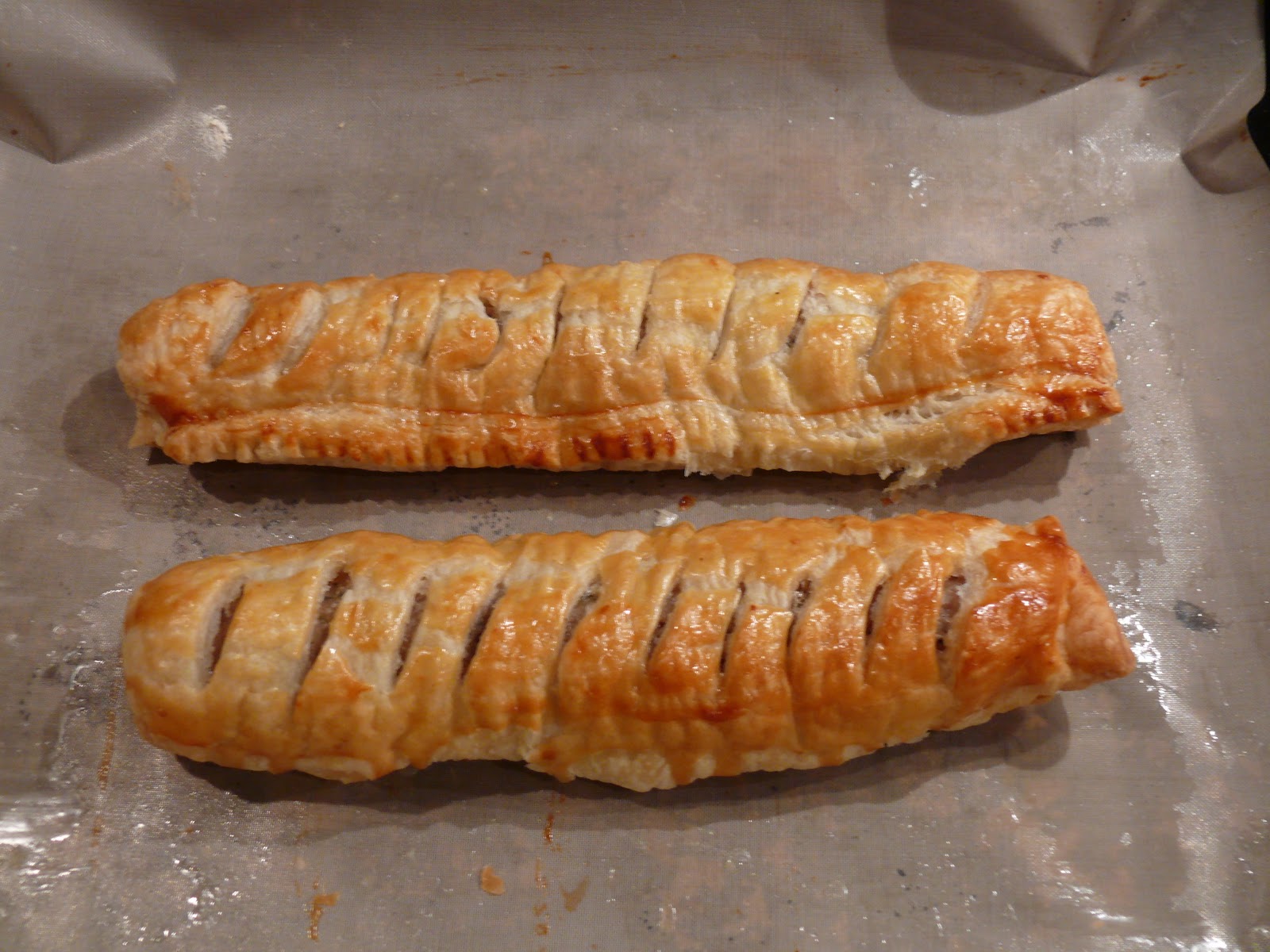
Sunday snack: sausage rolls
Yesterday, on Saturday Kitchen, Rick Stein showed his recipe for corned beef hash, served with ketchup. Food snobs may have baulked but ketchup definitely has its place in the kitchen, especially with sausage rolls, as I'm sure you remember from your younger years.
Of course, you can buy them ready made at the supermarket and heat them in the oven, but it is so much more satisfying to make your own. They make a delicious snack with a drink in the evening.
Unless you wish to go the whole hog and make your own sausage meat and pastry, you need only three ingredients: puff pastry, sausage meat and an egg yolk. Dust the worktop and roll the pastry out to 3-4 mm thick. If you can't find sausage meat, use sausages and remove the skin. You can add some herbs, mustard or finely chopped apples. As you can see in the photo above, I was rather generous with the sausage meat - another benefit of making your own. Fold the pastry over the meat and press it closed using some egg yolk and a fork. Trim the ends and cut some vents into the top. Glaze with egg wash and place on a baking tray. I use a silicon liner which is guaranteed non-stick. Bake in the oven at 180 degrees celsius for 15-20 minutes.
| Roll the pastry to 3-4 mm thickness |
| Fold the pastry over the sausage meat and seal |
| Cut vents into the top and glaze with egg |
| Bake on a non stick tray for 15-20 minutes until golden brown |
Cut into bite size portions and serve with tomato ketchup.
Wednesday, 17 November 2010
Tuesday, 16 November 2010
Squid salad with red peppers, burdock and romanesco
There are quite a few pubs along the river between Putney and Hammersmith bridges but most of them, in my opinion, are duds that are too complacent to offer anything but a good location. The Crabtree is an exception - we ate there for the first time on Sunday and were impressed with the food, the service and the atmosphere. We have never had to put "family friendly" on our list of criteria, but ours was not the only pram.
Jemma had roast beef, I had roast pork and we shared a sticky toffee pudding. So we only wanted something light for supper that evening. I scoured the fridge and decided on a salad of things that needed to be used up: some squid, some red peppers, some burdock roots that my mum had grown and a romanesco that I bought at North End Road market (a romanesco is a cross between a broccoli and a cauliflower). It's nice when you come up with something that you haven't seen before in a restaurant or a recipe book, but it doesn't happen that often and when it does, there's usually a reason it hasn't been tried before. These particular ingredients, by accident of being in the fridge and near their best by date, worked surprisingly well together so I thought I would post the recipe.
Serves 2
Time 45 minutes
Cost: £2.50 per serving
Ingredients
1-2 whole squid
3 tablespoons of plain flour
Salt and pepper
1-2 red peppers
Half a romanesco
2-3 burdock roots
1 teaspoon soy sauce
2 teaspoons mirin (or sake with a teaspoon of sugar)
Salad leaves
For the dressing:
2 tablespoons walnut or sunflower oil
1 teaspoon rice wine vinegar (or white wine vinegar)
1 teaspoon lemon juice
1 teaspoon soy sauce
1 teaspoon Dijon mustard
1. Put the grill on high. Put the red peppers in a roasting dish under the grill. Put some sunflower or vegetable oil in another baking tray to heat up.
2. Wash the squid and cut into rings or triangles. Dry with kitchen towel.
3. The skins of red peppers should have started to char under the grill. If so, turn them.
4. Season the flour very generously with the salt and pepper. Coat the squid in flour and set aside.
5. Cut the romanesco into small florets and steam over boiling water for 5 minutes.
6. Remove the red peppers from the grill and leave to cool. Put some oil in the baking tray and leave under the grill to heat up.
7. Cut the burdock root into shards or julienne strips. Fry in a little oil, then add the soy sauce and mirin. Lightly braise for 5 minutes. Burdock has a unique taste and you may find it in Asian supermarkets. If not, use celery, for texture.
8. When the oil is hot, add the squid and grill on one side for 2-3 minutes.
9. Remove the romanesco florets, cool in cold water and drain. Rinse some salad leaves and toss them with the dressing and romanesco. Place in a shallow bowl.
10. Cut the red peppers into strips, removing any seeds. Add on top of the salad leaves and romanesco.
11. Turn the squid and grill on the other side for a further 2-3 minutes.
12. Add the warm burdock shards and squid on top of the peppers.
Masterchef The Professionals
I didn't make this, but I had to share it. I was stifling my hysterics last night when I saw it because Hector had just gone to sleep.
http://www.youtube.com/watch?v=PjckqAU8IkM
Sunday, 14 November 2010
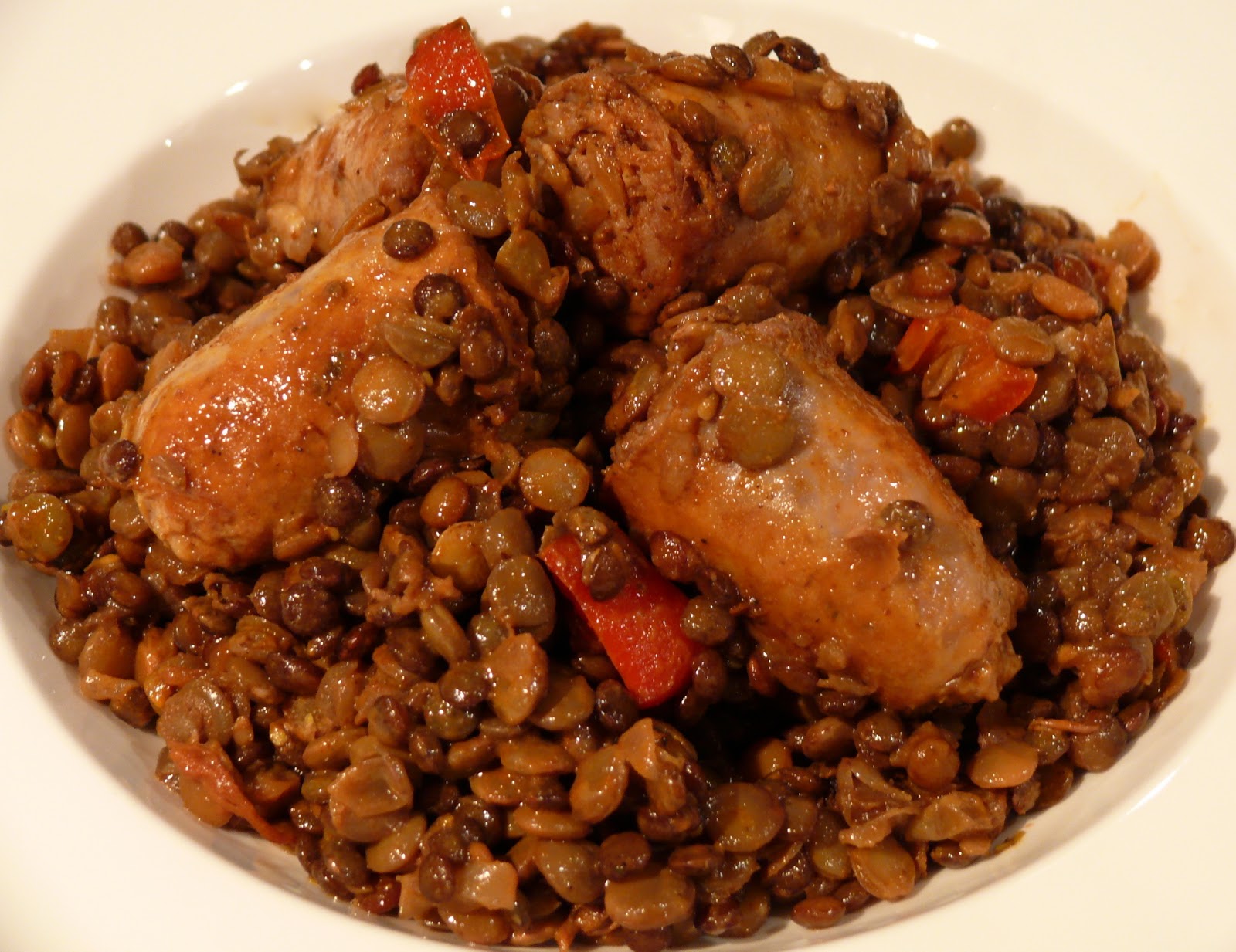
Sunday recipe: sausages and lentils
| Sausages and lentils |
On Saturday mornings, I like to go to the street market on North End Road. For one British pound, you can get a large stainless steel bowl of fruit or vegetables. In one bowl, I collected 15 red tomatoes on the vine, 8 avocados in another and 2 large shiny aubergines in a third. £3. It is cheap because everything is seasonal and ripe. Quid pro quo, you have to go shopping without any particular recipes in mind, be a little flexible and inventive and make sure you eat or cook everything within a couple of days. Weekends are perfect for market shopping because there is time to cook and invite friends round.
I decided to make three dips: salsa bruschetta, baba ganoush and guacamole. I dunked the tomatoes into a saucepan of boiling water for a minute so I could peel and deseed them for the salsa. I discarded the skins and chopped the flesh for the salsa, but I had some left over, as well as all the seeds and tomato juice. I didn't like to waste them so I put them in the fridge, not yet knowing what I was going to do with them, and got on with making my dips.
On Sunday, Jemma went to the supermarket for things that you can't get at North End Road market, like nappies and baby wipes. She came back with two packets of sausages which were on special offer. I now had sausaged, some lentils in the store cupboard and the leftover tomatoes. so I decided to make a recipe I initially found in Delia's Frugal Food. It has become a favourite meal because it is a tasty comfort food, cheap and quick to prepare.
Delia's recipe serves 4 and takes about an hour to make, but I think you can make it inside 30 minutes and add more lentils so that it makes 6-8 servings. The extra servings can be frozen and reheated in the microwave later in the week.
Serves: up to 8 (depending how many sausages in a pack)
Time: 20-30 minutes
Cost: About £1 per serving
Ingredients:
2 packets of sausages
1 packet (500g) of green or puy lentils (I used half and half)
1 litre of cold water
1 onion
2 cloves of garlic
1 tin of chopped or plum tomatoes (I used my left overs)
1 teaspoon of sugar
1 teaspoon of herbes de Provence (or mixed herbs)
1. In a frying pan, brown the sausages in a little oil over a medium heat.
| 1. Brown the sausages in a non-stick frying pan |
2. Rinse the green or puy lentils in a sieve and put them into a large saucepan with the water. Bring to the boil then turn down to simmer for 10 minutes.
3. Finely chop the onion and garlic. Add to the sausages.
| 3. Add the onions and garlic to the sausages. |
4. Add the tomatoes, sugar and herbs to the lentils. You should notice their sweet fragrance as they warm up.
| 4. I used half green lentils and half puy lentils. |
5. By now, the sausages should have browned and the onions softened. Cut the sausages into half and tip them into the saucepan with the lentils.
6. Deglaze the frying pan with a glass of water or wine. This will help collect all of the caramelised flavours and also starts the washing up process! Add this to the saucepan.
7. Turn the heat down to low and cook for at least another 10 minutes.
8. Taste and season, but there should be enough salt from the sausages and the lentils are naturally peppery.
As I am slightly obsessed with using up left overs, I also threw in some roughly chopped red peppers for a speck of colour and extra sweetness. I think it is best served with some crusty white bread and butter, preferably cold and unsalted.
Subscribe to:
Posts (Atom)