Half Scottish, Half Japanese. Tempura Mars bar?

My photo
I began writing this blog in October 2010 as a new father documenting food in his family. Before I knew it, I was in the final of MasterChef 2012. Now cooking is no longer just a hobby.
Showing posts with label Weekend recipes. Show all posts

Tuesday, 31 January 2012

Sunday Chicken Part 1


Last week, I recalled the childhood story of Stone Soup, which MiMi remembers as Nail Soup. I have since discovered that it is also known as Axe Soup in Russia and parts of Eastern Europe. This week, childhood nostalgia also took me to Eastern Europe. Chicken Kiev, may have originated in Moscow in the early 1900s but takes its name from the capital city of Ukraine. It was popularised in Britain in the late 1970s by Marks and Spencer as what they called a 'recipe dish', or a 'ready meal' in other words. By the 1980s, it was a dinner party favourite.

The first thing you will need to do for this dish is make a compound butter. "Beurre composé," by its French culinary term in Larousse, is just butter with other ingredients mixed through it; garlic, lemon and parsley in this case, but you can make Asian compound butters with chilli and spices. You might as well take a whole pack of butter, since you can freeze it and use it for other dishes. Soften the butter in a bowl. You can use a microwave on a low setting but don't melt it as the ingredients will sink to the bottom if it is not still semi-solid. Peel 3 or 4 garlic cloves and mince them finely with a knife or use a garlic press. Fold the garlic into the softened butter, along with the zest of a lemon and a handful of chopped flat leaf parsley (or coriander, if you prefer). Spoon the compound butter back into the packet or onto some foil and roll it into a log. Put it in the freezer for 20 minutes.


Garlic compound butter
1x 250g pack of salted butter
4 cloves of garlic
Zest of 1 lemon
Large handful of flat leaf parsley (2 tbsp once chopped)

Once the compound butter has set hard, preheat the oven to 180 Celsius and start making the Chicken Kiev. Take 2 chicken breasts and trim off the mini-fillets and any rough edges. Set these aside to make chicken burgers for the children. There are two approaches to filling the chicken breast with the compound butter. I went for the incision approach. Take a sharp, but narrow bladed knife and insert it into the middle of the chicken breast. Swivel it a little to form a pocket but be careful not to go through the fillet. Slice the frozen compound butter into shards and stuff them into the pocket. When you make the incisions, try and make them so that they face upwards when you place the chicken fillet on a baking tray. This way, when the garlic butter melts, it will have a more difficult job leaking out.

Make an incision but go in from a higher angle than this

The alternative method is to butterfly the chicken breast first and flatten it. The advantage of this method is that the finished cutlet will cook more evenly. The disadvantage is that it is a little more work and breading it may be more fiddly. Furthermore, if you don't have a meat mallet, you may have to use a saucepan.

Jay using his initiative. If you don't have a meat mallet, improvise.
If you go for the flattened approach, you will have to fold the chicken breast carefully around the frozen butter. Next, set up a pané station (pané is French for breaded).

Breadcrumbs, seasoned flour, egg
Chicken Kiev ingredients
1 chicken breast per portion
Garlic compound butter, above
1 egg, beaten
3 tbsp plain flour, seasoned with salt and pepper
4 tbsp of breadcrumbs (make your own in a food processor or buy ready made) 

Dip the chicken in the flour first, then the egg, then the breadcrumbs. If you want  thicker crust, repeat the "egg-flour" stage. The chicken breast on the right has an unfortunate bald patch - this is where I was holding it with my thumb.


Shallow fry the chicken breast in vegetable oil on both sides, then transfer to a baking tray. Use one with sides, in case the butter melts and makes a mess in the oven. Bake in the oven at 180 Celsius for about 15 minutes. By then the butter will be molten, but basting the chicken from the inside to keep it from being dry. Personally, to complete the nostalgia effect, I would serve it with fries; potato wants to soak up the garlicky juices but retains its crispness. However, on this occasion, I served it with lentils and cabbage, both of which I wanted to use up. I simmered the lentils in chicken stock for about 15 minutes, while the Kiev was in the oven, then added shredded cabbage for the last couple of minutes.

Sunday, 5 June 2011

Clear gazpacho


Jemma and I took Hector on his first trip abroad to Mallorca, to attend the wedding of Laura and Ralph, in the picturesque town of Deia. It was a busy half time flight and Hector behaved well. Sadly, although we were lucky enough to stay in the Nock family's beautiful Finca in the neighbouring village of Fornalutz, it was the worst night's sleep either of us have had since Hector was born. He struggled to cope with the heat and was up through the night, too uncomfortable to sleep.

We perked up in the morning with freshly squeezed local oranges, black coffee and ensaimadas - a Mallorcan breakfast pastry. A few hours later, we were enjoying fresh lemonade (large, local lemons with thick, fragrant and unwaxed skins), gazpacho and Spanish cured meats. Jemma isn't a big fan of chilled soups, but has come round to gazpacho, with the rich umami of ripe tomatoes, the sweetness of red peppers, refreshing cucumbers and the spiciness of raw garlic.

Coincidentally, the night before we departed for Mallorca, we hosted a dinner party, at which we served a type of clear gazpacho. It came from a Raymond Blanc recipe for tomato essence, which he uses to make a colourless tomato risotto. I wasn't sure what I was going to make with it, but I'd also seen it served with pickled cucumbers and sea trout tartare at Medlar restaurant. I loved the tomato taste without the coarse texture of the tomato pulp and decided to serve it on its own as a chilled, clear tomato soup.

The secret to getting just the clear tomato juice is to let it hang in a muslin - I made the mistake of squeezing the pulp through the bag. This yielded more liquor, but also the cloudiness and colour of the tomatoes. I was able to salvage it by letting the heavier red pulp sink and skim off the colourless liquid with a turkey baster. I kept the red liquid, added some more tabasco and heated it with a couple of leaves of gelatine to make a tomato jelly. I cut this into cubes and served it in the soup, along with diced, de-seeded cucumber, shredded basil leaves, chive oil and purple chive flowers.

Ingredients - serves 4
1 kg cherry tomatoes
1 stick celery, chopped
1/2 small onion, finely chopped
1 clove garlic, sliced
1/2 sprig thyme leaves
5 basil leaves
1 teaspoon salt
3 drops tabasco or large pinch of cayenne pepper

Method
1. Halve or quarter the tomatoes straight into a food processor or smoothie jug.
2. Add the rest of the ingredients and pulse three times, for 2 seconds.
3. Leave the ingredients to infuse in the refrigerator for up to 3 hours.
4. Place the tomato mix in a sieve lined with muslin or cheese cloth.
5. Leave over a pan for several hours to collect the tomato water. Do not squeeze!
6. The water collected should be clear.
7. If you squeeze rthe muslin bag, you can use the red juice to make a tomato jelly.
8. Simmer the pulp with some water and sieve it to make a passata by removing the skins and seeds.
9. You can also turn the passata into a tomato soup by adding red lentils and chicken stock.

Friday, 18 March 2011

Chocolate and hazelnut buns


This week on Masterchef the contestants faced a vegetarian test. I wasn't sure whether to be amused or uncomfortable when Yotam Ottolenghi told James (the carpenter from Milton Keynes) that he "looked like a carnivore". James responded awkardly "That's alright, you look like a rabbit."

Torode and Wallace couldn't decide who should join Kennedy in leaving the competition. In my view, Tom, Sara and James all failed to shine, but the judges overlooked the fact that James glaringly defeated the object by producing "the only dessert". I wouldn't have minded if he'd been inventive enough to produce a dessert using naturally sweet vegetables such as carrots or sweetcorn.

I have now abstained from meat for over a week and although I haven't missed it too much I have found it challenging to cook without it. I have found that Middle Eastern and South Asian cuisines lend themselves to a vegetarian diet. You can enliven vegetables, pulses or tofu with strong flavours such as cumin, chilli, coriander and ginger. Moreover, meze style dishes and curries are less exposed to the absence of animal protein than the 'meat and two veg' format. Here are some of the things I have been cooking this week:

Cauliflower fritters with chilli and coriander yoghurt
Thai red curry with aubergine, mushrooms and green beans
Asian chick pea salad with peppers, soy sauce and sesame dressing
Butter bean and cauliflower jalfrezi
Sweet potato and cauliflower coconut curry
Chick pea and spinach curry
Lentil moussaka

I tried a vegetarian Japanese restaurant near Kings Cross for lunch on Tuesday but I wasn't compelled. I enjoy pickled vegetables, steamed greens, braised carrots, sesame dressed seaweed as side dishes or condiments, but a bento box needs some grilled fish or meat!

My biggest temptation this week was sausages. The prospect of home baked white bread, pork and leek sausages, rocket and chilli jam was very tempting. To assuage my temptation, I made Chocolate and Hazelnut buns (this doesn't count as packaged chocolate, which I have also given up for Lent).

Thanks to Matt for pointing me in the direction of Dan Lepard's sour cream white bread - I shall try it this weekend. Here is the recipe for Chocolate and Hazelnut buns.

For the dough:
350g strong white flour
10g dry yeast (a generous teaspoon)
5g salt (half a teaspoon)
20g sugar
50g melted butter
1 beaten egg
150ml warm milk

For the filling:
100g of chopped hazelnuts
75g sugar
25 g cocoa

1. Mix all the dough ingredients together and knead by hand or food processor for 5 minutes.
2. Put the dough in a bowl, cover with cling film or a damp tea towel and leave for 2 hours.
3. Go for a run or read the papers while the dough is rising.
4. Preheat the oven to 180 Celcius, prepare the chocolate hazelnut filling and make the buns.


5. Blend the hazelnuts, cocoa and sugar together in a food processor for a 30-60 seconds.


6. Roll the dough out to somewhere between an A4 and A3 sheet of paper (1-2cm thick).
7. Spread about 25g-50g softened butter over the dough to absorb the filling.
8. Sprinkle the chocolate filling over the butter.
Sprinkle the chocolate filling over the butter.


9. Roll the dough from the long side.
10. Cut the rolled dough log at about 4cm intervals.
11. Grease a baking tin, or line with silicone lining.
12. Put the rolls next to each other - so that they have soft sides when you break them apart.
Cut the rolled dough log at about 4cm intervals.


13. Bake for 25 minutes, until they are golden brown.
14. Leave to cool in the tin for 10 minutes, then turn out onto a cooling tray.

Wednesday, 16 March 2011

White bread


Is it just me or are there a lot of chefs on TV? Raymond Blanc's Kitchen Secrets, Heston's Mission Impossible, Michel Roux Jnr on The Great British Food Revival. Even Jamie's Dream School. In years gone by, I would be lapping it up, but I am left a bit disillusioned by it all. Are the margins in top end catering really so poor that these talented chefs have to be making TV programmes of such dubious quality?

I like Raymond Blanc. He is genuine, funny and conveys his enthusiasm for food. But I don't get the point of the programme. He is hardly revealing Kitchen Secrets and the recipes he demonstrates are just too complicated to tempt many viewers to try them.

I think I still like Heston Blumenthal. His devotion and idiosyncrasy are unique and inspiring but he is the wrong person to be attempting to improve catering standards in the UK. He is too whacky to revive institutions such as the NHS and British Airways. In his previous series, he came across well only by contrast to the odious Ian Pegler, the Managing Director of Little Chef. In this current series, he is even more pie in the sky and I can't tell whether its the producers egging him on. Either way, the social agenda and demonisation of a bureaucratic antihero is hackneyed, patronising and irritating.

And yet another programme called "The Great British Something". I support TV programmes that educate consumers and promote sustainable food resources, but I felt last week's episode was clumsily done. For a start, it paired Michel Roux (on artisan bread) with the Hairy Bikers (on cauliflower). For me, Michel Roux's message was confusing. On the one hand, he was arguing that artisan bread has very few ingredients and is simple to make. On the other, he presented a loaf that contained flour, milk, butter, golden syrup and yeast and told us that there were "no short cuts".

The good news is that bread really is simple to make. What surprises many people is that no kneading is required and no bread machine either. Bread machines definitely fall into the category of impulse purchase that will take up space first on your countertop and later in your cupboard as the novelty wears off. All you need is a mixing bowl and a saucepan with a lid. I learned all of this from my friends Jon and Helen, who first introduced me to "No knead bread" in the New York Times. They have evolved their own recipe and process.

Making your own bread isn't going to save you a lot of money (before you even fire up the oven, a 1.5kg bag of flour is pushing £2). And although the method is very straightforward it does need several hours to rise so you can't really make it on the spur of the moment. But it is satisfying and a nice thing to do at the weekends. Left to rise for too long, the dough will smell boozy and taste yeasty - so don't leave it any more than 12 hours. I try to make the dough last thing on a Friday night, leave it to rise overnight, allow it to prove first thing in the morning and bake it for breakfast or brunch.

Ingredients:
500g of Strong White Flour (plain flour just won't work as well)
1 teaspoon of dried yeast (about 7g)
1 teaspoon of salt
375g of luke warm water (use 75% water to flour as a rule of thumb).

Method:
1. Mix all of the ingredients using a silicone spatula for about a minute until you have a ball of dough.
2. Cover with cling film or a damp cloth and leave to rise for a minimum of 4 hours.
3. When the dough has doubled in size, fold it over a few times. Dust it in flour, cover and leave for a further 20-30 minutes.
4. Put the saucepan in the oven and heat it up to 220 Celsius.
5. Make sure the dough ball is coated in flour and put it into the saucepan. Put the lid on and bake for 15 minutes.
6. After 15 minutes, take the lid off. The dough should have risen but will still be white. Bake for a further 20 minutes to allow the crust to brown and caramelise slightly.
7. Leave to cool on a cooling rack.

Give it a go, take a photo and let me know how it goes. Make sure your saucepan is oven-proof. I melted the handles on one pot that was meant only for use on the stove! A cast iron Le Creuset pot is ideal!

Friday, 10 December 2010

Lamb kebabs with flatbread, baba ganoush and tzatziki

Middle Eastern version of fajitas


I classify this as a recipe for the weekend because the lamb benefits from some marinading and skewering the meat and vegetables can be fiddly. It can, however, be a quick weekday meal, if it has been prepared a day in advance and left in the fridge.

I had made baba ganoush (aubergine dip) previously and had some lamb chops in the fridge so I decided to make a Middle Eastern version of fajitas, using baba ganoush instead of guacamole and tzatziki instead of sour cream. I headed to North End Road in Fulham, which is lined with Middle Eastern delicatessens where you can buy lots of interesting imported foods. I bought some flat bread, some Turkish yoghurt and some cumin seeds.

I've always been a bit agnostic as to the difference between a fajita and a burrito, so I decided to look it up. Although 'fajar' means 'to wrap' in Spanish, the name originally comes from 'faja' referring to the cut of meat (skirt steak) that was used. 'Burrito' means little ass in Spanish, which is topical given that I am writing this in December. The name may have been suggested because the rolled up tortilla vaguely resembles the ear of a donkey. Either way, burritos are generally served closed and the fillings are slow cooked, such as braised meat and refried beans.

Serves: 2
Preparation: 30 minutes, plus at least an hour marinading
Cooking time: 15 minutes
Cost: £3-4 per head

Marinade
4 Lamb chops, chopped into inch cubes
1 teaspoon of cumin seeds, freshly ground with a pestle and mortar
2 cloves of garlic, sliced or pressed
Juice of 1/2 lemon
1 tablespoon of olive oil

Kebabs
2 skewers per person (if using wooden ones, soak in water to prevent burning)
Marinated lamb
1 large red pepper, chopped into inch squares
12 button mushrooms
1 large onion, cut into 6 segments and then halved

To serve
Flatbread, microwaved or toasted in a dry frying pan
Baba ganoush (aubergine dip)
Tzatziki
Spiced rice

Prepare the kebabs by alternating lamb, onions, mushroom and red pepper. Place under the grill and turn every 3-4 minutes to prevent burning. I used a silicon baking sheet, to prevent them from sticking.


You can make the spiced rice like you would a risotto, while the kebabs are under the grill. Finely chop a small onion and a stick of celery and fry in a little olive oil with a pinch of cumin seeds for 3 minutes. Add 100g of long grain rice and fry for a further couple of minutes. Add vegetable stock bit by bit, until the rice is cooked in about 10-15 minutes. Remove the kebabs from under the grill, add the juices from the lamb to the rice and sprinkle with some cayenne pepper.

Sunday, 21 November 2010

Sunday snack: sausage rolls


Yesterday, on Saturday Kitchen, Rick Stein showed his recipe for corned beef hash, served with ketchup. Food snobs may have baulked but ketchup definitely has its place in the kitchen, especially with sausage rolls, as I'm sure you remember from your younger years.

Of course, you can buy them ready made at the supermarket and heat them in the oven, but it is so much more satisfying to make your own. They make a delicious snack with a drink in the evening.

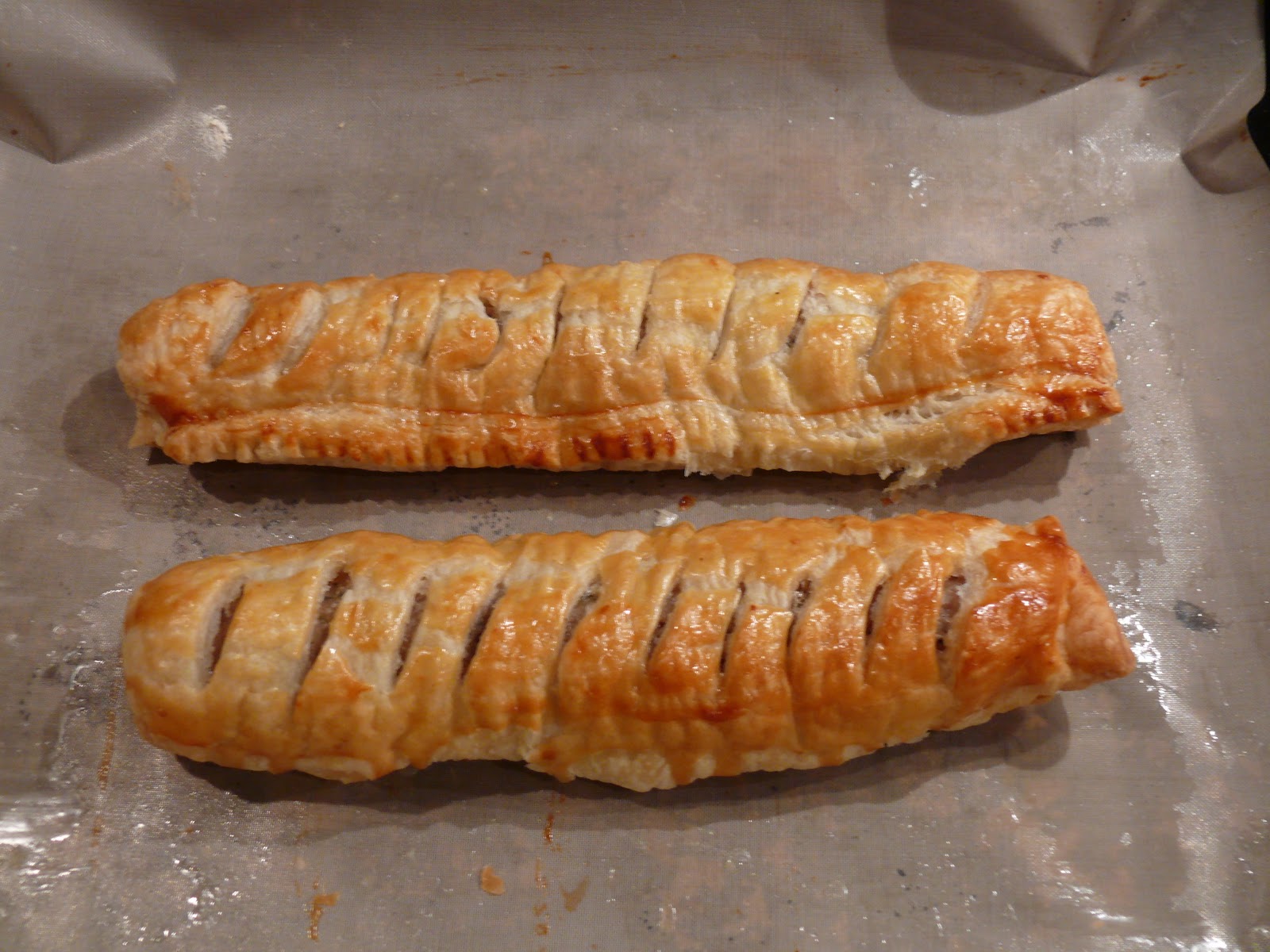
Unless you wish to go the whole hog and make your own sausage meat and pastry, you need only three ingredients: puff pastry, sausage meat and an egg yolk. Dust the worktop and roll the pastry out to 3-4 mm thick. If you can't find sausage meat, use sausages and remove the skin. You can add some herbs, mustard or finely chopped apples. As you can see in the photo above, I was rather generous with the sausage meat - another benefit of making your own. Fold the pastry over the meat and press it closed using some egg yolk and a fork. Trim the ends and cut some vents into the top. Glaze with egg wash and place on a baking tray. I use a silicon liner which is guaranteed non-stick. Bake in the oven at 180 degrees celsius for 15-20 minutes.

Roll the pastry to 3-4 mm thickness
Fold the pastry over the sausage meat and seal

Cut vents into the top and glaze with egg
Bake on a non stick tray for 15-20 minutes until golden brown
Cut into bite size portions and serve with tomato ketchup.

Tuesday, 16 November 2010

Squid salad with red peppers, burdock and romanesco


There are quite a few pubs along the river between Putney and Hammersmith bridges but most of them, in my opinion, are duds that are too complacent to offer anything but a good location. The Crabtree is an exception - we ate there for the first time on Sunday and were impressed with the food, the service and the atmosphere. We have never had to put "family friendly" on our list of criteria, but ours was not the only pram.

Jemma had roast beef, I had roast pork and we shared a sticky toffee pudding. So we only wanted something light for supper that evening. I scoured the fridge and decided on a salad of things that needed to be used up: some squid, some red peppers, some burdock roots that my mum had grown and a romanesco that I bought at North End Road market (a romanesco is a cross between a broccoli and a cauliflower). It's nice when you come up with something that you haven't seen before in a restaurant or a recipe book, but it doesn't happen that often and when it does, there's usually a reason it hasn't been tried before. These particular ingredients, by accident of being in the fridge and near their best by date, worked surprisingly well together so I thought I would post the recipe.

Serves 2
Time 45 minutes
Cost: £2.50 per serving

Ingredients

1-2 whole squid
3 tablespoons of plain flour
Salt and pepper
1-2 red peppers
Half a romanesco
2-3 burdock roots
1 teaspoon soy sauce
2 teaspoons mirin (or sake with a teaspoon of sugar)
Salad leaves

For the dressing:
2 tablespoons walnut or sunflower oil
1 teaspoon rice wine vinegar (or white wine vinegar)
1 teaspoon lemon juice
1 teaspoon soy sauce
1 teaspoon Dijon mustard

1. Put the grill on high. Put the red peppers in a roasting dish under the grill. Put some sunflower or vegetable oil in another baking tray to heat up.
2. Wash the squid and cut into rings or triangles. Dry with kitchen towel.
3. The skins of red peppers should have started to char under the grill. If so, turn them.
4. Season the flour very generously with the salt and pepper. Coat the squid in flour and set aside.
5. Cut the romanesco into small florets and steam over boiling water for 5 minutes.
6. Remove the red peppers from the grill and leave to cool. Put some oil in the baking tray and leave under the grill to heat up.
7. Cut the burdock root into shards or julienne strips. Fry in a little oil, then add the soy sauce and mirin. Lightly braise for 5 minutes. Burdock has a unique taste and you may find it in Asian supermarkets. If not, use celery, for texture.
8. When the oil is hot, add the squid and grill on one side for 2-3 minutes.
9. Remove the romanesco florets, cool in cold water and drain. Rinse some salad leaves and toss them with the dressing and romanesco. Place in a shallow bowl.
10. Cut the red peppers into strips, removing any seeds. Add on top of the salad leaves and romanesco.
11. Turn the squid and grill on the other side for a further 2-3 minutes.
12. Add the warm burdock shards and squid on top of the peppers.

Sunday, 14 November 2010

Sunday recipe: sausages and lentils

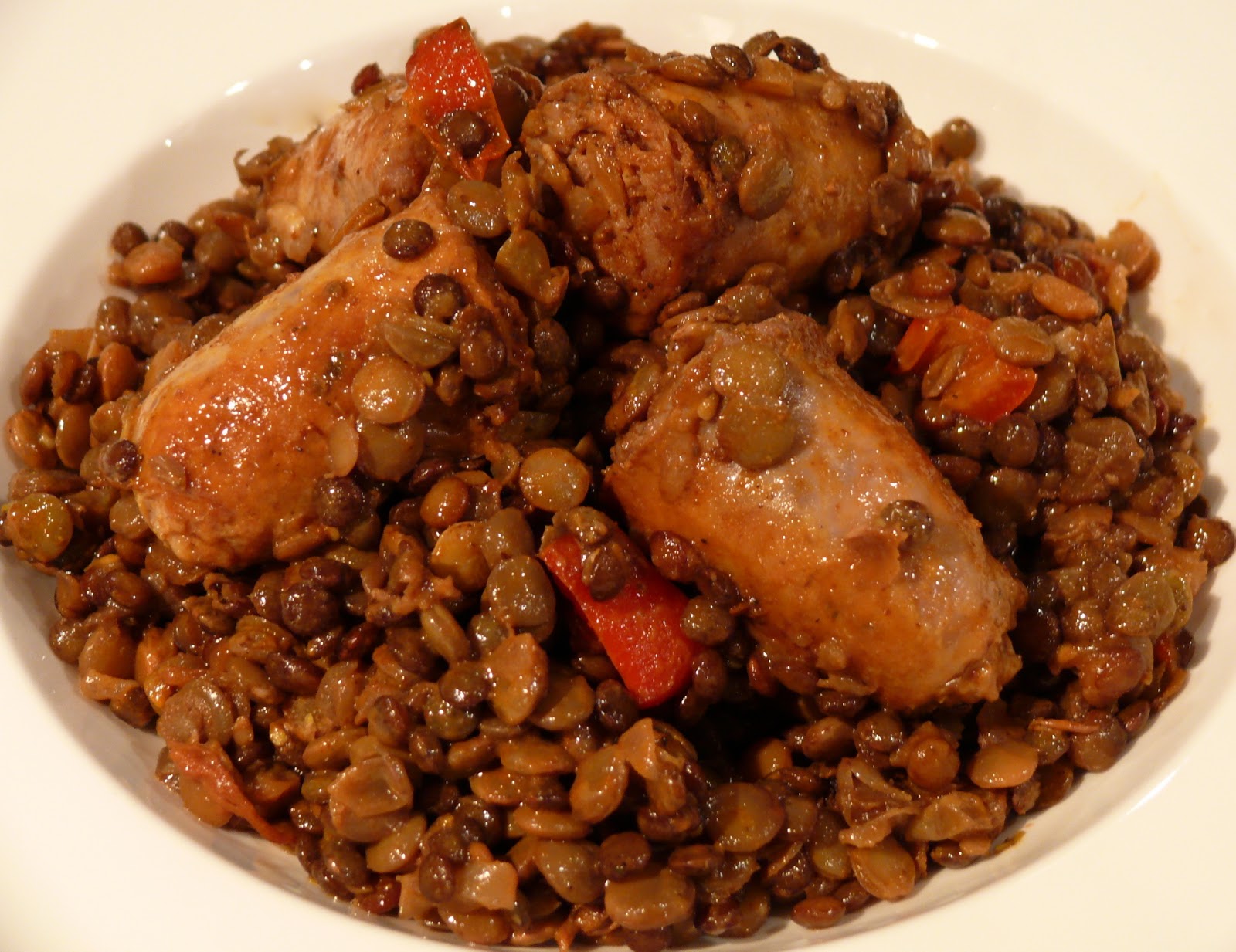
Sausages and lentils


On Saturday mornings, I like to go to the street market on North End Road. For one British pound, you can get a large stainless steel bowl of fruit or vegetables. In one bowl, I collected 15 red tomatoes on the vine, 8 avocados in another and 2 large shiny aubergines in a third. £3. It is cheap because everything is seasonal and ripe. Quid pro quo, you have to go shopping without any particular recipes in mind, be a little flexible and inventive and make sure you eat or cook everything within a couple of days. Weekends are perfect for market shopping because there is time to cook and invite friends round.

I decided to make three dips: salsa bruschetta, baba ganoush and guacamole. I dunked the tomatoes into a saucepan of boiling water for a minute so I could peel and deseed them for the salsa. I discarded the skins and chopped the flesh for the salsa, but I had some left over, as well as all the seeds and tomato juice. I didn't like to waste them so I put them in the fridge, not yet knowing what I was going to do with them, and got on with making my dips.

On Sunday, Jemma went to the supermarket for things that you can't get at North End Road market, like nappies and baby wipes. She came back with two packets of sausages which were on special offer. I now had sausaged, some lentils in the store cupboard and the leftover tomatoes. so I decided to make a recipe I initially found in Delia's Frugal Food. It has become a favourite meal because it is a tasty comfort food, cheap and quick to prepare.

Delia's recipe serves 4 and takes about an hour to make, but I think you can make it inside 30 minutes and add more lentils so that it makes 6-8 servings. The extra servings can be frozen and reheated in the microwave later in the week.

Serves: up to 8 (depending how many sausages in a pack)
Time: 20-30 minutes
Cost: About £1 per serving

Ingredients:

2 packets of sausages
1 packet (500g) of green or puy lentils (I used half and half)
1 litre of cold water
1 onion
2 cloves of garlic
1 tin of chopped or plum tomatoes (I used my left overs)
1 teaspoon of sugar
1 teaspoon of herbes de Provence (or mixed herbs)


1. In a frying pan, brown the sausages in a little oil over a medium heat.

1. Brown the sausages in a non-stick frying pan


2. Rinse the green or puy lentils in a sieve and put them into a large saucepan with the water. Bring to the boil then turn down to simmer for 10 minutes.
3. Finely chop the onion and garlic. Add to the sausages.
3. Add the onions and garlic to the sausages.


4. Add the tomatoes, sugar and herbs to the lentils. You should notice their sweet fragrance as they warm up.
4. I used half green lentils and half puy lentils.


5. By now, the sausages should have browned and the onions softened. Cut the sausages into half and tip them into the saucepan with the lentils.
6. Deglaze the frying pan with a glass of water or wine. This will help collect all of the caramelised flavours and also starts the washing up process! Add this to the saucepan.
7. Turn the heat down to low and cook for at least another 10 minutes.
8. Taste and season, but there should be enough salt from the sausages and the lentils are naturally peppery.

As I am slightly obsessed with using up left overs, I also threw in some roughly chopped red peppers for a speck of colour and extra sweetness. I think it is best served with some crusty white bread and butter, preferably cold and unsalted.