On Saturday, I completed my first ever triathlon in the beautiful setting of Blenheim Palace. Although I chose the shortest distance (Super Sprint: 400m swim, 10k bike, 3k run), I was proud of the achievement because a month ago, I could hardly swim one length, let alone two, without stopping and gasping for breath. All it took was two very good lessons with a personal trainer who taught himself to swim by analysing others (ralph-hydes.com).
A few hours after completing the triathlon, I had the privilege of meeting and cooking with some of Great Britain's Olympic triathlon medal prospects, the Brownlee brothers, Alistair and Jonathan and Helen Jenkins and her husband and trainer, Marc, who himself competed in the triathlon in the Olympic Games in Athens.
Helen and Marc helped me cook a Japanese noodle dish that I had come up with, while the Brownlee brothers joined fellow Yorkshireman Tom Rennolds, who is my friend and fellow finalist from MasterChef.
I wanted my dish to be quick to prepare, light and fresh with a good balance of carbohydrates, vegetables and protein.
Ingredients (serves 2-3)
2 quail
1/2 red onion
1 stick celery
1 carrot
1 orange
1 spring onion
200g broad beans, shelled
50g spinach
50g watercress
1/4 red onion, finely sliced
1 spring onion, finely sliced
5-6 French breakfast radishes, finely sliced
Handful of celery leaves
1 tbsp Sesame oil
2 tbsp Soy sauce (reduced salt, preferably)
2 tbsp Mirin
200g soba (buckwheat) noodles
Method
1. Remove any string from the quail. Slice off the breasts and reserve. You can also remove the legs if you wish, but I used them to make a quail broth. You can always grill them later, after they have been poached in the broth.
2. Place the quail carcasses into water and bring to the boil. As the water is boiling, roughly chop the red onion, carrot, spring onion and celery. Plave them in the water with the quail. I leave the skin on the onion as it helps give the broth a deep reddy-brown colour. Once the water is boiling, reduce to a low simmer - you want the flavours of the quail and vegetables to infuse into the water gently. If it boils too vigorously, the fatwand impurities will emulsify into the water, resulting in a cloudy stock. You want a fresh, light consomme.
3. Marinade the quail breasts in the sesame oil, soy sauce and mirin. It's best and easiest in a plastic freezer bag.
4. Boil the soba noodles according to the instructions on the packet. Err on the side of al dente, as you'll serve them in the hot quail broth later. Rinse and drain the noodles, then portion them into bowls. We'll reheat them later by pouring over the hot quail broth.
5. Prepare the vegetables. I like to serve them all raw, as it helps with the lightness of the dish while adding texture as some of the vegetables will wilt more than others in the broth. I prefer to shell the broadbeans - it is a little fiddly, but Marc and Heen both found it therapeutic! The beans inside have a much brighter green that looks better in the finished soup and the whitish shells are slightly bitter. Scatter the shelled broadbeans on top of the noodles, along with a handful of watercress, spinach, red onion, spring onion and radishes.
6. Once the quail broth has been brewing for 15-20 minutes, drain the stock into a new pan. You can remove the legs at this point if you wish - they will be poached and will just need to be tossed into the marinade and grilled. The stock should be a light golden colour, mainly from the carrot and red onion, but it will taste oand smell of quail. Season it with soy sauce instead of salt, to make it a richer, darker colour. Add a tablespoon of mirin for an extra bit of sweet acidity and perfume it by adding the zest of 1/2 an orange (use a peeler).
7. Remove the quail meat from the marinade and grill quickly over a high heat for 1-2 minutes on each side. Be careful not to overcook it as quail can become dry quickly.
8. Pour the quail broth over the noodles (without the orange peel), then place the grilled quail meat on top, with a large pinch of sesame seeds.
Half Scottish, Half Japanese. Tempura Mars bar?

- Koj
- I began writing this blog in October 2010 as a new father documenting food in his family. Before I knew it, I was in the final of MasterChef 2012. Now cooking is no longer just a hobby.
Showing posts with label Quick recipes. Show all posts
Showing posts with label Quick recipes. Show all posts
Sunday, 10 June 2012


Sunday, 5 February 2012
Sunday Chicken Part 2
 |
| Hector eating fish fingers on the beach |
Hector is a texture fiend - he loves anything crunchy or with a crispy coating. He particularly loves fish fingers, but I do worry how much salt and other things are added, when we are away from home. When I made Chicken Kiev, I was left with the inner fillets from the chicken breast and some extra breadcrumbs, so I made chicken patties, with just five ingredients.
Ingredients (makes about 4 small patties)
250g chicken meat
1 egg
1 tbsp coriander
1 tbsp polenta
1 tbsp bread crumbs
Method
1. Place the chicken meat and coriander in a food processor and pulse for 10 seconds. Scrape the sides down and pulse further if necessary, but keep the texture rough.
2. Add the egg and pulse for 5 seconds. The pattie mix will be quite runny.
3. Add the polenta until the pattie mix is stiff but remains sticky.
4. Take 2 tbsp of mix and form it into a pattie.
5. Flatten the patty and dip both sides in the breadcrumbs.
6. Fry on both sides for 3 minutes (depends how thick the patties are).
If you don't have a food processor, you can chop the chicken by hand and mix in the egg and polenta with a spoon and mixing bowl.

Monday, 8 August 2011
Nose to tail beetroot
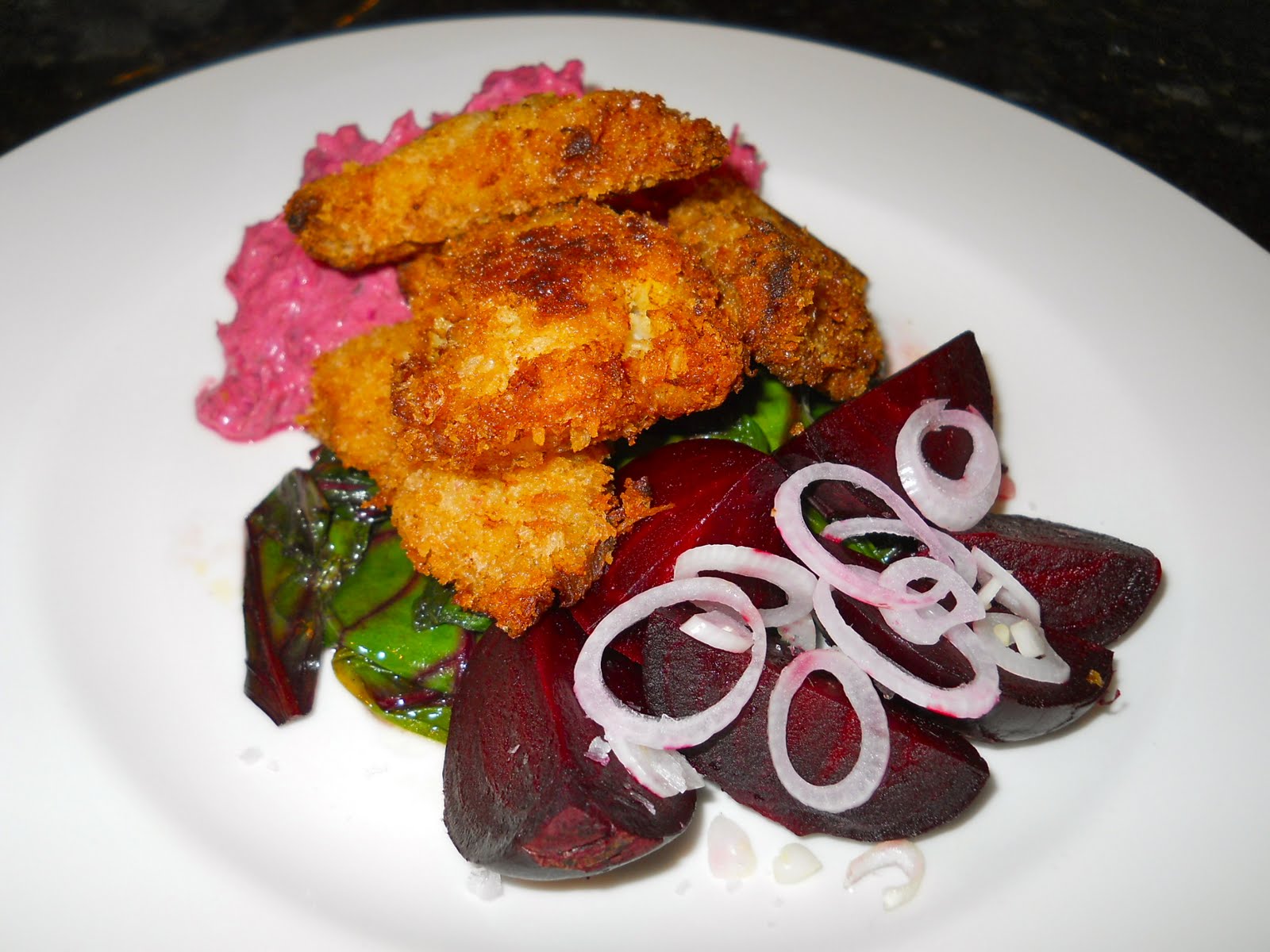
Hector is now eating three square meals a day. He generally has Weetabix and fruit for breakfast, pasta or cous cous for lunch and meat and two veg for supper. The problem with cooking for him is that his portions are so small that any normal batch of food will go off in the fridge before he has eaten it all. Therefore we generally resort to cooking at the weekends and freezing excess portions.
This weekend we had an excess of home made fish fingers so we decided to help him out. The fridge was somewhat bare as we haven't been shopping for a while, but fortunately my mum had sent us home with some baby beetroot plucked fresh from the garden on Saturday evening. Fish fingers and beetroot isn't an obvious pairing but necessity is the mother of invention...
The beetroot, being home grown, came with stalks and leaves so I decided to make the most of them. I cooked the beetroot themselves in salted water for 20 minutes, then separated the green leaves from the red stalks. Breadcrumbed food usually needs a sauce, so I made a beetroot tartare sauce from the stalks. I chopped them roughly and added them to a couple of cloves of garlic that had been sweated in a little butter. When they were cooked, I blitzed them in the smoothie maker with some greek yoghurt to loosen it. Some fronds of dill would have been lovely, but I didn't have any. It needed salt, more garlic (so I added dried garlic granules) and some heat (so I added cayenne pepper).
I decided to treat the beetroot leaves as I would spinach - sauteed in butter and served as a bed for the rest of the dish. They are slightly bitter, so I added a little orange zest to give it a distracting fragrance. Jemma thought it was a touch overpowering, so next time I might simply add some spinach to dilute the bitterness. I don't like the idea of throwing the leaves away, not just because of the waste, but because the red veins make them more attractive on the plate.
Wednesday, 16 March 2011
White bread

Is it just me or are there a lot of chefs on TV? Raymond Blanc's Kitchen Secrets, Heston's Mission Impossible, Michel Roux Jnr on The Great British Food Revival. Even Jamie's Dream School. In years gone by, I would be lapping it up, but I am left a bit disillusioned by it all. Are the margins in top end catering really so poor that these talented chefs have to be making TV programmes of such dubious quality?
I like Raymond Blanc. He is genuine, funny and conveys his enthusiasm for food. But I don't get the point of the programme. He is hardly revealing Kitchen Secrets and the recipes he demonstrates are just too complicated to tempt many viewers to try them.
I think I still like Heston Blumenthal. His devotion and idiosyncrasy are unique and inspiring but he is the wrong person to be attempting to improve catering standards in the UK. He is too whacky to revive institutions such as the NHS and British Airways. In his previous series, he came across well only by contrast to the odious Ian Pegler, the Managing Director of Little Chef. In this current series, he is even more pie in the sky and I can't tell whether its the producers egging him on. Either way, the social agenda and demonisation of a bureaucratic antihero is hackneyed, patronising and irritating.
And yet another programme called "The Great British Something". I support TV programmes that educate consumers and promote sustainable food resources, but I felt last week's episode was clumsily done. For a start, it paired Michel Roux (on artisan bread) with the Hairy Bikers (on cauliflower). For me, Michel Roux's message was confusing. On the one hand, he was arguing that artisan bread has very few ingredients and is simple to make. On the other, he presented a loaf that contained flour, milk, butter, golden syrup and yeast and told us that there were "no short cuts".
The good news is that bread really is simple to make. What surprises many people is that no kneading is required and no bread machine either. Bread machines definitely fall into the category of impulse purchase that will take up space first on your countertop and later in your cupboard as the novelty wears off. All you need is a mixing bowl and a saucepan with a lid. I learned all of this from my friends Jon and Helen, who first introduced me to "No knead bread" in the New York Times. They have evolved their own recipe and process.
Making your own bread isn't going to save you a lot of money (before you even fire up the oven, a 1.5kg bag of flour is pushing £2). And although the method is very straightforward it does need several hours to rise so you can't really make it on the spur of the moment. But it is satisfying and a nice thing to do at the weekends. Left to rise for too long, the dough will smell boozy and taste yeasty - so don't leave it any more than 12 hours. I try to make the dough last thing on a Friday night, leave it to rise overnight, allow it to prove first thing in the morning and bake it for breakfast or brunch.
Ingredients:
500g of Strong White Flour (plain flour just won't work as well)
1 teaspoon of dried yeast (about 7g)
1 teaspoon of salt
375g of luke warm water (use 75% water to flour as a rule of thumb).
Method:
1. Mix all of the ingredients using a silicone spatula for about a minute until you have a ball of dough.
2. Cover with cling film or a damp cloth and leave to rise for a minimum of 4 hours.
3. When the dough has doubled in size, fold it over a few times. Dust it in flour, cover and leave for a further 20-30 minutes.
4. Put the saucepan in the oven and heat it up to 220 Celsius.
5. Make sure the dough ball is coated in flour and put it into the saucepan. Put the lid on and bake for 15 minutes.
6. After 15 minutes, take the lid off. The dough should have risen but will still be white. Bake for a further 20 minutes to allow the crust to brown and caramelise slightly.
7. Leave to cool on a cooling rack.
Give it a go, take a photo and let me know how it goes. Make sure your saucepan is oven-proof. I melted the handles on one pot that was meant only for use on the stove! A cast iron Le Creuset pot is ideal!
Tuesday, 28 December 2010
Easy roast soup

Yesterday, on the bank holiday after Boxing Day, I took Hector to Le Pain Quotidien. I reflected on my Christmas excess and contemplated a healthier 2011, over a pot of coffee and 2 slices of toast, spread liberally with butter and strawberry jam. Meanwhile, Jemma was taking a more practical approach by setting out on a 4 mile run - her first proper run since she stopped running over six months ago, while pregnant with Hector.
We are both planning to run a marathon in June. It is set in the Lewa Wildlife Reserve in Northern Kenya, so it will be hot, dry and at altitude. With only 128 runners last year, we are likely to be at the back of the pack. We have almost six months to train, but we have both decided that it will be a lot easier if we can shed a few kilograms!
I wanted to make a soup that would be low in fat but nourishing and filling. I also wanted one that was simple and quick to make. I had some ingredients that I thought would go well together: potatoes, garlic, cannellini beans and fresh herbs. The Spanish make garlic soup, thickened with potatoes or bread. I decided that thyme would go well with garlic and potatoes and that rosemary would go well with the cannellini beans, which are more of an Italian ingredient. For convenience, I put the garlic straight into a cast iron pot that could be left in the oven - less likely to burn if I had to attend to Hector and less washing up.
Potato and cannellini bean soup, with garlic, rosemary and thyme
Serves: 4
Preparation: 15 minutes
Cooking time: 1 hour
Cost: £0.50 per portion
Ingredients:
1 tablespoon of olive oil
1 onion, chopped
5 cloves garlic, peeled
Pinch each of salt and mixed herbs
350g potatoes
1 tin of cannelini beans
600ml of water (about 2 tinfuls)
1 stock cube (chicken or vegetable)
2-3 sprigs of rosemary
2-3 sprigs of thyme
 |
| Stages 2 and 3 |
 |
| Stages 4 and 5 |
 |
| Stage 6 |
1. Preheat the oven to 170 celsius.
2. Drizzle the bottom of the pot with olive oil and season it with a few twists of salt and a large pinch of mixed herbs.
3. Add 5 peeled cloves of garlic and one chopped onion and put it in the oven for 10 minutes.
4. While the garlic is softening (both in texture and taste), peel 350g of potatoes and chop them up into smaller chunks.
5. Make a bouquet garni of rosemary and thyme by chopping the sprigs and tying them inside a small bag of muslin (to save fishing them out at the end).
6. Add the potatoes, bouquet garni, tin of cannellini beans, 2 tinfuls of water and a stock cube to the pan.
7. Cover with a lid and cook in the oven for an hour.
8. Blend with a handheld blender, season with salt and white pepper.
9. Garnish with olive oil and paprika.
Wednesday, 1 December 2010
Mid-week recipe: beef and mange tout stir fry
Apologies for radio silence. We are currently snowed in without internet access, but thanks to the wonders of modern connectivity, I realised that I am able to write and post this using my phone. We are in an isolated farm house in the Peak District, almost a mile from the nearest hamlet, Priestcliffe, which is half a mile from the A6 between Bakewell and Buxton (the former noted for the Bakewell Tart, the latter for its mineral water).
Fortunately, the central heating is working and we have enough food to keep us going until Friday, when Mr Tibble from Priestcliffe will hopefully come with his tractor and help get our car to the A6. We have plenty of leftovers because we were renting the cottage with friends, who were sensible enough to leave after the weekend before the heavy snowfall. Each of the four couples had been assigned a meal to cook for the weekend. Since I had prepared a fore rib roast of beef during my butchery lesson at the Ginger Pig, we volunteered to do Sunday lunch. Short-break rental cottages can be frustrating: blunt knives, imprecise electric hobs and a complete lack of even the most basic store cupboard ingredients. With that in mind, we packed salt and pepper mills, eggs, flour, a baking tray for the Yorkshire pudding, a carving knife, horseradish sauce and mustard (English, Dijon and wholegrain). We managed to leave London before 3pm, hoping to avoid weekend traffic on the M1. On the way, somewhere along the North Circular near Ealing, I realised we had left the beef in the freezer. Good thing it was Jim and Claudia who were responsible for dinner that night and not us. Claudia pan fried some chicken legs and thighs and served them with a tarragon and shallot sauce.
It snowed that night, but Chris and Kate also had to buy provisions for their chocolate fondant pudding and blueberry pancakes, so the three of us ventured into Buxton on Saturday morning. Supermarkets rarely sell a beef joint big enough to feed eight and invariably it is already off the bone, so I headed for the local butchers. Roasting beef on the bone is tastier and more fun for the table, but it needs to be chined to make it easy to carve. A good local butcher will chine it for you and French trim the ribs (scrape away any meat that might burn). He gave me the bones for stock and some trimmings to baste the meat. Three kilograms of beef was enough for eight people and cost the same, per kilo, as the supermarket. We served it with roast potatoes, roast parsnips, Yorkshire pudding, honeyed carrots and braised red cabbage with apples. And gravy, lots of gravy. Jim was quite right to point out that the ribs were as prized as the slices of beef and others were quick on the uptake. It could have served ten without seconds but what is a Sunday roast without seconds? You need plenty of gravy to warm up the seconds.
Although Jemma loves Sunday roasts, she doesn't like cold meat leftovers. There was a nice piece of chuck or brisket steak attached to some of the fat that the butcher had given me so I carved it off and set it aside for later in the week. Since there was rice left over from John and Helen's Thai Green Curry, I planned a beef and mange tout stir fry. It needs marinating, but preparation and cooking takes less than 15 minutes, so it makes a great mid-week meal. All the better that it cost virtually nothing.
Serves: 2
Cost: less than £2 per head
Time: 5-10 minutes preparation, 30 minutes marinade, 5-10 minutes cooking
Ingredients:
300g beef (fillet tails or frying steak, but avoid stewing or braising steak)
3 tablespoon soy sauce
2 tablespoon mirin
1-2 cloves of garlic
2cm of ginger
2-3 spring onions
1 packet of mange tout (or sugar snap peas)
Method:
Cut the beef into thin strips so that you can cook it quickly on a high heat. If you use a low heat, the beef will be chewy and tough, even if you buy expensive beef.
Slice or chop the garlic and ginger and add with the soy sauce and mirin to the beef. I used white wine vinegar and sugar instead of mirin.
Leave in the marinade for at least 30 minutes (or a day or two in advance).
Cook the beef and the marinade in a hot non-stick frying pan. After 2-3 minutes, add some spring onions (sliced on the diagonal) and the mange tout.
Stir fry for a further 2-3 minutes and serve with rice.
Fortunately, the central heating is working and we have enough food to keep us going until Friday, when Mr Tibble from Priestcliffe will hopefully come with his tractor and help get our car to the A6. We have plenty of leftovers because we were renting the cottage with friends, who were sensible enough to leave after the weekend before the heavy snowfall. Each of the four couples had been assigned a meal to cook for the weekend. Since I had prepared a fore rib roast of beef during my butchery lesson at the Ginger Pig, we volunteered to do Sunday lunch. Short-break rental cottages can be frustrating: blunt knives, imprecise electric hobs and a complete lack of even the most basic store cupboard ingredients. With that in mind, we packed salt and pepper mills, eggs, flour, a baking tray for the Yorkshire pudding, a carving knife, horseradish sauce and mustard (English, Dijon and wholegrain). We managed to leave London before 3pm, hoping to avoid weekend traffic on the M1. On the way, somewhere along the North Circular near Ealing, I realised we had left the beef in the freezer. Good thing it was Jim and Claudia who were responsible for dinner that night and not us. Claudia pan fried some chicken legs and thighs and served them with a tarragon and shallot sauce.
It snowed that night, but Chris and Kate also had to buy provisions for their chocolate fondant pudding and blueberry pancakes, so the three of us ventured into Buxton on Saturday morning. Supermarkets rarely sell a beef joint big enough to feed eight and invariably it is already off the bone, so I headed for the local butchers. Roasting beef on the bone is tastier and more fun for the table, but it needs to be chined to make it easy to carve. A good local butcher will chine it for you and French trim the ribs (scrape away any meat that might burn). He gave me the bones for stock and some trimmings to baste the meat. Three kilograms of beef was enough for eight people and cost the same, per kilo, as the supermarket. We served it with roast potatoes, roast parsnips, Yorkshire pudding, honeyed carrots and braised red cabbage with apples. And gravy, lots of gravy. Jim was quite right to point out that the ribs were as prized as the slices of beef and others were quick on the uptake. It could have served ten without seconds but what is a Sunday roast without seconds? You need plenty of gravy to warm up the seconds.
Although Jemma loves Sunday roasts, she doesn't like cold meat leftovers. There was a nice piece of chuck or brisket steak attached to some of the fat that the butcher had given me so I carved it off and set it aside for later in the week. Since there was rice left over from John and Helen's Thai Green Curry, I planned a beef and mange tout stir fry. It needs marinating, but preparation and cooking takes less than 15 minutes, so it makes a great mid-week meal. All the better that it cost virtually nothing.
Serves: 2
Cost: less than £2 per head
Time: 5-10 minutes preparation, 30 minutes marinade, 5-10 minutes cooking
Ingredients:
300g beef (fillet tails or frying steak, but avoid stewing or braising steak)
3 tablespoon soy sauce
2 tablespoon mirin
1-2 cloves of garlic
2cm of ginger
2-3 spring onions
1 packet of mange tout (or sugar snap peas)
Method:
Cut the beef into thin strips so that you can cook it quickly on a high heat. If you use a low heat, the beef will be chewy and tough, even if you buy expensive beef.
Slice or chop the garlic and ginger and add with the soy sauce and mirin to the beef. I used white wine vinegar and sugar instead of mirin.
Leave in the marinade for at least 30 minutes (or a day or two in advance).
Cook the beef and the marinade in a hot non-stick frying pan. After 2-3 minutes, add some spring onions (sliced on the diagonal) and the mange tout.
Stir fry for a further 2-3 minutes and serve with rice.
Subscribe to:
Posts (Atom)