Half Scottish, Half Japanese. Tempura Mars bar?

My photo
I began writing this blog in October 2010 as a new father documenting food in his family. Before I knew it, I was in the final of MasterChef 2012. Now cooking is no longer just a hobby.
Showing posts with label Main Course. Show all posts

Monday, 8 August 2011

Nose to tail beetroot


Hector is now eating three square meals a day. He generally has Weetabix and fruit for breakfast, pasta or cous cous for lunch and meat and two veg for supper. The problem with cooking for him is that his portions are so small that any normal batch of food will go off in the fridge before he has eaten it all. Therefore we generally resort to cooking at the weekends and freezing excess portions.

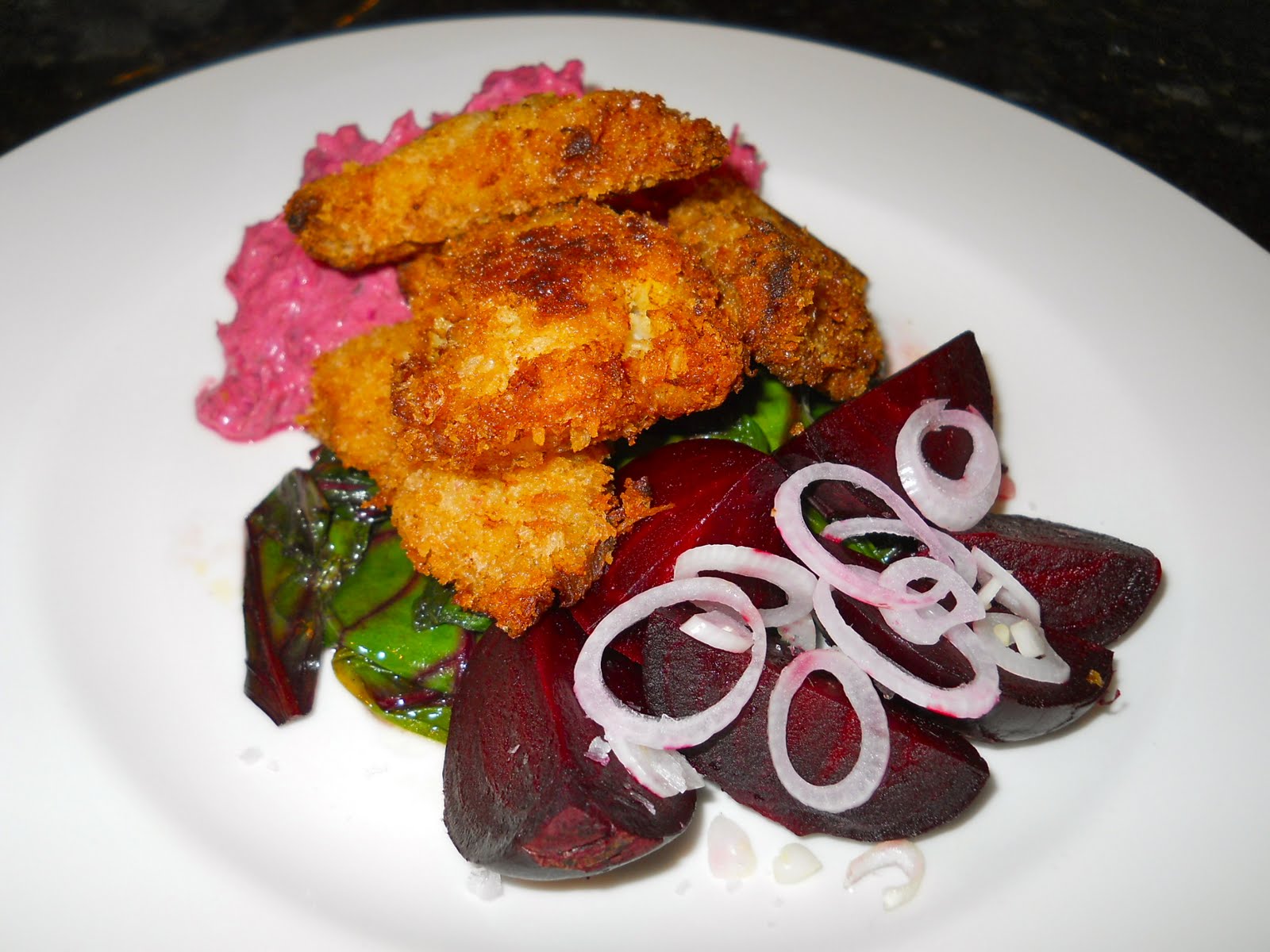
This weekend we had an excess of home made fish fingers so we decided to help him out. The fridge was somewhat bare as we haven't been shopping for a while, but fortunately my mum had sent us home with some baby beetroot plucked fresh from the garden on Saturday evening. Fish fingers and beetroot isn't an obvious pairing but necessity is the mother of invention...

The beetroot, being home grown, came with stalks and leaves so I decided to make the most of them. I cooked the beetroot themselves in salted water for 20 minutes, then separated the green leaves from the red stalks. Breadcrumbed food usually needs a sauce, so I made a beetroot tartare sauce from the stalks. I chopped them roughly and added them to a couple of cloves of garlic that had been sweated in a little butter. When they were cooked, I blitzed them in the smoothie maker with some greek yoghurt to loosen it. Some fronds of dill would have been lovely, but I didn't have any. It needed salt, more garlic (so I added dried garlic granules) and some heat (so I added cayenne pepper).

I decided to treat the beetroot leaves as I would spinach - sauteed in butter and served as a bed for the rest of the dish. They are slightly bitter, so I added a little orange zest to give it a distracting fragrance. Jemma thought it was a touch overpowering, so next time I might simply add some spinach to dilute the bitterness. I don't like the idea of throwing the leaves away, not just because of the waste, but because the red veins make them more attractive on the plate.

Tuesday, 28 December 2010

Easy roast soup


Yesterday, on the bank holiday after Boxing Day, I took Hector to Le Pain Quotidien. I reflected on my Christmas excess and contemplated a healthier 2011, over a pot of coffee and 2 slices of toast, spread liberally with butter and strawberry jam. Meanwhile, Jemma was taking a more practical approach by setting out on a 4 mile run - her first proper run since she stopped running over six months ago, while pregnant with Hector.

We are both planning to run a marathon in June. It is set in the Lewa Wildlife Reserve in Northern Kenya, so it will be hot, dry and at altitude. With only 128 runners last year, we are likely to be at the back of the pack. We have almost six months to train, but we have both decided that it will be a lot easier if we can shed a few kilograms!

I wanted to make a soup that would be low in fat but nourishing and filling. I also wanted one that was simple and quick to make. I had some ingredients that I thought would go well together: potatoes, garlic, cannellini beans and fresh herbs. The Spanish make garlic soup, thickened with potatoes or bread. I decided that thyme would go well with garlic and potatoes and that rosemary would go well with the cannellini beans, which are more of an Italian ingredient. For convenience, I put the garlic straight into a cast iron pot that could be left in the oven - less likely to burn if I had to attend to Hector and less washing up.


Potato and cannellini bean soup, with garlic, rosemary and thyme

Serves: 4
Preparation: 15 minutes
Cooking time: 1 hour
Cost: £0.50 per portion

Ingredients:
1 tablespoon of olive oil
1 onion, chopped
5 cloves garlic, peeled
Pinch each of salt and mixed herbs
350g potatoes
1 tin of cannelini beans
600ml of water (about 2 tinfuls)
1 stock cube (chicken or vegetable)
2-3 sprigs of rosemary
2-3 sprigs of thyme

Stages 2 and 3
Stages 4 and 5


Stage 6


1. Preheat the oven to 170 celsius.
2. Drizzle the bottom of the pot with olive oil and season it with a few twists of salt and a large pinch of mixed herbs.
3. Add 5 peeled cloves of garlic and one chopped onion and put it in the oven for 10 minutes.
4. While the garlic is softening (both in texture and taste), peel 350g of potatoes and chop them up into smaller chunks.
5. Make a bouquet garni of rosemary and thyme by chopping the sprigs and tying them inside a small bag of muslin (to save fishing them out at the end).
6. Add the potatoes, bouquet garni, tin of cannellini beans, 2 tinfuls of water and a stock cube to the pan.
7. Cover with a lid and cook in the oven for an hour.
8. Blend with a handheld blender, season with salt and white pepper.
9. Garnish with olive oil and paprika.

Friday, 10 December 2010

Lamb kebabs with flatbread, baba ganoush and tzatziki

Middle Eastern version of fajitas


I classify this as a recipe for the weekend because the lamb benefits from some marinading and skewering the meat and vegetables can be fiddly. It can, however, be a quick weekday meal, if it has been prepared a day in advance and left in the fridge.

I had made baba ganoush (aubergine dip) previously and had some lamb chops in the fridge so I decided to make a Middle Eastern version of fajitas, using baba ganoush instead of guacamole and tzatziki instead of sour cream. I headed to North End Road in Fulham, which is lined with Middle Eastern delicatessens where you can buy lots of interesting imported foods. I bought some flat bread, some Turkish yoghurt and some cumin seeds.

I've always been a bit agnostic as to the difference between a fajita and a burrito, so I decided to look it up. Although 'fajar' means 'to wrap' in Spanish, the name originally comes from 'faja' referring to the cut of meat (skirt steak) that was used. 'Burrito' means little ass in Spanish, which is topical given that I am writing this in December. The name may have been suggested because the rolled up tortilla vaguely resembles the ear of a donkey. Either way, burritos are generally served closed and the fillings are slow cooked, such as braised meat and refried beans.

Serves: 2
Preparation: 30 minutes, plus at least an hour marinading
Cooking time: 15 minutes
Cost: £3-4 per head

Marinade
4 Lamb chops, chopped into inch cubes
1 teaspoon of cumin seeds, freshly ground with a pestle and mortar
2 cloves of garlic, sliced or pressed
Juice of 1/2 lemon
1 tablespoon of olive oil

Kebabs
2 skewers per person (if using wooden ones, soak in water to prevent burning)
Marinated lamb
1 large red pepper, chopped into inch squares
12 button mushrooms
1 large onion, cut into 6 segments and then halved

To serve
Flatbread, microwaved or toasted in a dry frying pan
Baba ganoush (aubergine dip)
Tzatziki
Spiced rice

Prepare the kebabs by alternating lamb, onions, mushroom and red pepper. Place under the grill and turn every 3-4 minutes to prevent burning. I used a silicon baking sheet, to prevent them from sticking.


You can make the spiced rice like you would a risotto, while the kebabs are under the grill. Finely chop a small onion and a stick of celery and fry in a little olive oil with a pinch of cumin seeds for 3 minutes. Add 100g of long grain rice and fry for a further couple of minutes. Add vegetable stock bit by bit, until the rice is cooked in about 10-15 minutes. Remove the kebabs from under the grill, add the juices from the lamb to the rice and sprinkle with some cayenne pepper.

Wednesday, 1 December 2010

Mid-week recipe: beef and mange tout stir fry

Apologies for radio silence. We are currently snowed in without internet access, but thanks to the wonders of modern connectivity, I realised that I am able to write and post this using my phone. We are in an isolated farm house in the Peak District, almost a mile from the nearest hamlet, Priestcliffe, which is half a mile from the A6 between Bakewell and Buxton (the former noted for the Bakewell Tart, the latter for its mineral water).

Fortunately, the central heating is working and we have enough food to keep us going until Friday, when Mr Tibble from Priestcliffe will hopefully come with his tractor and help get our car to the A6. We have plenty of leftovers because we were renting the cottage with friends, who were sensible enough to leave after the weekend before the heavy snowfall. Each of the four couples had been assigned a meal to cook for the weekend. Since I had prepared a fore rib roast of beef during my butchery lesson at the Ginger Pig, we volunteered to do Sunday lunch. Short-break rental cottages can be frustrating: blunt knives, imprecise electric hobs and a complete lack of even the most basic store cupboard ingredients. With that in mind, we packed salt and pepper mills, eggs, flour, a baking tray for the Yorkshire pudding, a carving knife, horseradish sauce and mustard (English, Dijon and wholegrain). We managed to leave London before 3pm, hoping to avoid weekend traffic on the M1. On the way, somewhere along the North Circular near Ealing, I realised we had left the beef in the freezer. Good thing it was Jim and Claudia who were responsible for dinner that night and not us. Claudia pan fried some chicken legs and thighs and served them with a tarragon and shallot sauce.

It snowed that night, but Chris and Kate also had to buy provisions for their chocolate fondant pudding and blueberry pancakes, so the three of us ventured into Buxton on Saturday morning. Supermarkets rarely sell a beef joint big enough to feed eight and invariably it is already off the bone, so I headed for the local butchers. Roasting beef on the bone is tastier and more fun for the table, but it needs to be chined to make it easy to carve. A good local butcher will chine it for you and French trim the ribs (scrape away any meat that might burn). He gave me the bones for stock and some trimmings to baste the meat. Three kilograms of beef was enough for eight people and cost the same, per kilo, as the supermarket. We served it with roast potatoes, roast parsnips, Yorkshire pudding, honeyed carrots and braised red cabbage with apples. And gravy, lots of gravy. Jim was quite right to point out that the ribs were as prized as the slices of beef and others were quick on the uptake. It could have served ten without seconds but what is a Sunday roast without seconds? You need plenty of gravy to warm up the seconds.

Although Jemma loves Sunday roasts, she doesn't like cold meat leftovers. There was a nice piece of chuck or brisket steak attached to some of the fat that the butcher had given me so I carved it off and set it aside for later in the week. Since there was rice left over from John and Helen's Thai Green Curry, I planned a beef and mange tout stir fry. It needs marinating, but preparation and cooking takes less than 15 minutes, so it makes a great mid-week meal. All the better that it cost virtually nothing.

Serves: 2
Cost: less than £2 per head
Time: 5-10 minutes preparation, 30 minutes marinade, 5-10 minutes cooking

Ingredients:
300g beef (fillet tails or frying steak, but avoid stewing or braising steak)
3 tablespoon soy sauce
2 tablespoon mirin
1-2 cloves of garlic
2cm of ginger
2-3 spring onions
1 packet of mange tout (or sugar snap peas)

Method:
Cut the beef into thin strips so that you can cook it quickly on a high heat. If you use a low heat, the beef will be chewy and tough, even if you buy expensive beef.
Slice or chop the garlic and ginger and add with the soy sauce and mirin to the beef. I used white wine vinegar and sugar instead of mirin.
Leave in the marinade for at least 30 minutes (or a day or two in advance).
Cook the beef and the marinade in a hot non-stick frying pan. After 2-3 minutes, add some spring onions (sliced on the diagonal) and the mange tout.
Stir fry for a further 2-3 minutes and serve with rice.

Tuesday, 16 November 2010

Squid salad with red peppers, burdock and romanesco


There are quite a few pubs along the river between Putney and Hammersmith bridges but most of them, in my opinion, are duds that are too complacent to offer anything but a good location. The Crabtree is an exception - we ate there for the first time on Sunday and were impressed with the food, the service and the atmosphere. We have never had to put "family friendly" on our list of criteria, but ours was not the only pram.

Jemma had roast beef, I had roast pork and we shared a sticky toffee pudding. So we only wanted something light for supper that evening. I scoured the fridge and decided on a salad of things that needed to be used up: some squid, some red peppers, some burdock roots that my mum had grown and a romanesco that I bought at North End Road market (a romanesco is a cross between a broccoli and a cauliflower). It's nice when you come up with something that you haven't seen before in a restaurant or a recipe book, but it doesn't happen that often and when it does, there's usually a reason it hasn't been tried before. These particular ingredients, by accident of being in the fridge and near their best by date, worked surprisingly well together so I thought I would post the recipe.

Serves 2
Time 45 minutes
Cost: £2.50 per serving

Ingredients

1-2 whole squid
3 tablespoons of plain flour
Salt and pepper
1-2 red peppers
Half a romanesco
2-3 burdock roots
1 teaspoon soy sauce
2 teaspoons mirin (or sake with a teaspoon of sugar)
Salad leaves

For the dressing:
2 tablespoons walnut or sunflower oil
1 teaspoon rice wine vinegar (or white wine vinegar)
1 teaspoon lemon juice
1 teaspoon soy sauce
1 teaspoon Dijon mustard

1. Put the grill on high. Put the red peppers in a roasting dish under the grill. Put some sunflower or vegetable oil in another baking tray to heat up.
2. Wash the squid and cut into rings or triangles. Dry with kitchen towel.
3. The skins of red peppers should have started to char under the grill. If so, turn them.
4. Season the flour very generously with the salt and pepper. Coat the squid in flour and set aside.
5. Cut the romanesco into small florets and steam over boiling water for 5 minutes.
6. Remove the red peppers from the grill and leave to cool. Put some oil in the baking tray and leave under the grill to heat up.
7. Cut the burdock root into shards or julienne strips. Fry in a little oil, then add the soy sauce and mirin. Lightly braise for 5 minutes. Burdock has a unique taste and you may find it in Asian supermarkets. If not, use celery, for texture.
8. When the oil is hot, add the squid and grill on one side for 2-3 minutes.
9. Remove the romanesco florets, cool in cold water and drain. Rinse some salad leaves and toss them with the dressing and romanesco. Place in a shallow bowl.
10. Cut the red peppers into strips, removing any seeds. Add on top of the salad leaves and romanesco.
11. Turn the squid and grill on the other side for a further 2-3 minutes.
12. Add the warm burdock shards and squid on top of the peppers.

Sunday, 14 November 2010

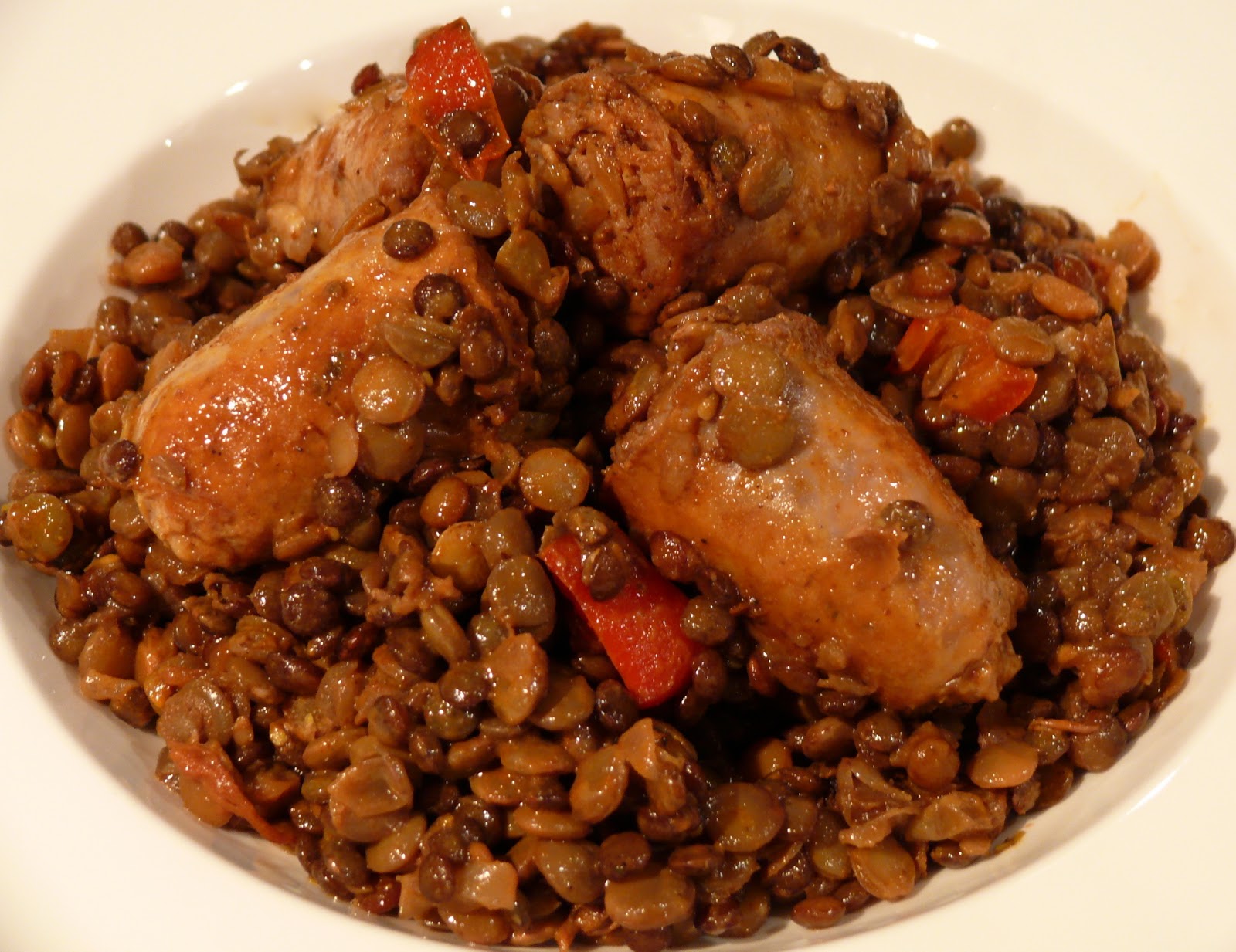
Sunday recipe: sausages and lentils

Sausages and lentils


On Saturday mornings, I like to go to the street market on North End Road. For one British pound, you can get a large stainless steel bowl of fruit or vegetables. In one bowl, I collected 15 red tomatoes on the vine, 8 avocados in another and 2 large shiny aubergines in a third. £3. It is cheap because everything is seasonal and ripe. Quid pro quo, you have to go shopping without any particular recipes in mind, be a little flexible and inventive and make sure you eat or cook everything within a couple of days. Weekends are perfect for market shopping because there is time to cook and invite friends round.

I decided to make three dips: salsa bruschetta, baba ganoush and guacamole. I dunked the tomatoes into a saucepan of boiling water for a minute so I could peel and deseed them for the salsa. I discarded the skins and chopped the flesh for the salsa, but I had some left over, as well as all the seeds and tomato juice. I didn't like to waste them so I put them in the fridge, not yet knowing what I was going to do with them, and got on with making my dips.

On Sunday, Jemma went to the supermarket for things that you can't get at North End Road market, like nappies and baby wipes. She came back with two packets of sausages which were on special offer. I now had sausaged, some lentils in the store cupboard and the leftover tomatoes. so I decided to make a recipe I initially found in Delia's Frugal Food. It has become a favourite meal because it is a tasty comfort food, cheap and quick to prepare.

Delia's recipe serves 4 and takes about an hour to make, but I think you can make it inside 30 minutes and add more lentils so that it makes 6-8 servings. The extra servings can be frozen and reheated in the microwave later in the week.

Serves: up to 8 (depending how many sausages in a pack)
Time: 20-30 minutes
Cost: About £1 per serving

Ingredients:

2 packets of sausages
1 packet (500g) of green or puy lentils (I used half and half)
1 litre of cold water
1 onion
2 cloves of garlic
1 tin of chopped or plum tomatoes (I used my left overs)
1 teaspoon of sugar
1 teaspoon of herbes de Provence (or mixed herbs)


1. In a frying pan, brown the sausages in a little oil over a medium heat.

1. Brown the sausages in a non-stick frying pan


2. Rinse the green or puy lentils in a sieve and put them into a large saucepan with the water. Bring to the boil then turn down to simmer for 10 minutes.
3. Finely chop the onion and garlic. Add to the sausages.
3. Add the onions and garlic to the sausages.


4. Add the tomatoes, sugar and herbs to the lentils. You should notice their sweet fragrance as they warm up.
4. I used half green lentils and half puy lentils.


5. By now, the sausages should have browned and the onions softened. Cut the sausages into half and tip them into the saucepan with the lentils.
6. Deglaze the frying pan with a glass of water or wine. This will help collect all of the caramelised flavours and also starts the washing up process! Add this to the saucepan.
7. Turn the heat down to low and cook for at least another 10 minutes.
8. Taste and season, but there should be enough salt from the sausages and the lentils are naturally peppery.

As I am slightly obsessed with using up left overs, I also threw in some roughly chopped red peppers for a speck of colour and extra sweetness. I think it is best served with some crusty white bread and butter, preferably cold and unsalted.

Monday, 25 October 2010

A cooking mishap


On Friday afternoon, I received a very welcome phone call. My friends Tom and Tash had booked themselves a butchery class at The Ginger Pig. Unfortunately, Tash couldn't make it because of work and Tom asked if I would like to go with him. I had long earmarked butchery skills as something I would like to learn, so I jumped at the opportunity. In the days before Hector, I might have had plans for Friday night, but as all I had planned was trying to figure what to make with some pork tenderloin and a couple of leeks, I set off towards Marylebone on a Boris bike.

It was every bit as good as its reputation. For the first half of the evening, the two butchers, Perry and Borut, taught eleven of us about beef by demonstration and hands on experience, where we learned about dry ageing, different cuts and how to cook them. For the second half, we used saws and knives to prepare our own fore rib roast. We learned how to chine a rib roast so that you can carve it easily, how to tie it with string so that it doesn't fall apart and how to French trim the rib bones so that they don't burn. We left with vastly improved knowledge of beef, a fore rib roast that will easily feed six and a belly full of roast beef and merlot.

On Sunday, the pork tenderloin and leeks were still in the fridge approaching their use by date. I decided to use cling film and a rolling pin to flatten the loin so that I could stuff it and practise my tying technique. I gently fried some sliced leeks in a little butter. Once they were softened, I took them off the heat and added half a teaspoon of wholegrain mustard, half a teaspoon of Dijon mustard, a couple of tablespoons of Philadelphia and some grated cheddar cheese. I rolled the stuffing inside the pork loin with the help of some cling film and tried to remember how to tie the knots. The technique is difficult enough to teach in person, let alone describe in words. You place a ball of string in your pocket and tease the other end through a series of over and under manoeuvres to produce a slip knot that you can tighten around the meat. After a couple of attempts, I remembered the sequence and grinned with smug satisfaction as the first string tightened around the pork.

At this point, Jemma called me to see something Hector was doing but as I left the kitchen, I heard the rustling of carrier bags. Thinking it was a mouse, I stopped in my tracks and tried to pinpoint the noise. Each time I inched forward, the rustling continued, as though the mouse were daring me to find him. Jemma called out again so I decided to leave the mouse to his rummaging. About half way to the sitting room, I heard a thwack and ran back to try and catch him in the act. I returned to find my carefully rolled pork loin on the kitchen tiles, cheese and leek stuffing oozing through the seams. My "mouse" was attached to the pork at one end by a carefully tied slip knot. He left a trail running across the kitchen floor, behind the bin, down the corridor and into the ball of string in my pocket. If only I'd pinpointed the rustling sound, I would have seen the pork in its cling film, inching its way from the countertop to the floor, as I crept around the kitchen in search of the mouse. Next time I'll cut the string as soon as I've tied the knot.

Wednesday, 13 October 2010

Comfort Food

Earlier this year, Heston Blumenthal created his version of Pot Noodles. Like any convenience food worth its salt, Pot Noodles are packed with umami. Umami was identified as a separate taste over 100 years ago in Japan and means "good flavour". It is a rich savoury flavour that is more than just salty. As well as Pot Noodles, you find umami in Marmite and many Asian foods.

Jemma and I have recently rediscovered Old El Paso fajitas. They are not only packed with umami but very simple to prepare, making a convenient mid-week meal for new parents. Fast and efficient food preparation is especially important this week. Hector is hungrier this week and we suspect it is because babies often have a growth spurt after 2-3 weeks. Also, we wanted to catch the second episode of The Apprentice.

The umami of the Smoky BBQ flavour pack, combined with the tang of the salsa, a soothing smear of guacamole and a cooling dollop of soured cream. For me, there is also the satisfying teeth-feel as you bite into the tortilla. It gets messy though, because although I can roll, I haven't mastered closing the end.

I would like to take tortilla folding lessons at Benito's Hat, where they manage to fit an unfeasible amount of ingredients into their burritos. Both of their outlets (Goodge Street and Covent Garden) are a short walk from SOAS, where I am taking Japanese lessons. I recommend the pork, it is super-slow braised with lime juice, balsamic vinegar, black pepper, cumin and oregano. Umami.